
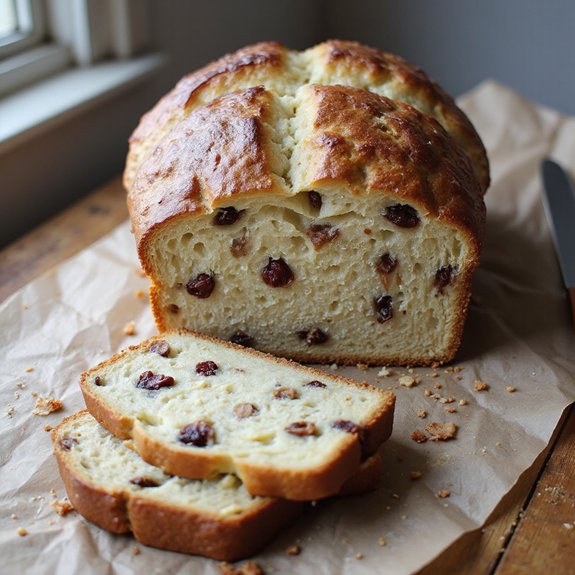
There’s something about a crackly, glossy crust dusted with sugar that instantly whispers “treat.”
Picture a golden sourdough loaf, its swirled interior marbled with cinnamon, chocolate, or pockets of jam, filling your kitchen with a warm, toasty aroma.
This cozy dessert-style bread turns classic sourdough into a sweet indulgence that’s perfect for relaxed weekends or slow Sunday baking, yet simple enough for sourdough beginners to master with a little patience.
It’s made for sweet-tooth fans, families, and comfort seekers who love a slice of something special with coffee or as a not-too-sweet dessert.
I still remember pulling my first dessert sourdough from the oven after a long, gray week—the first bite, slightly warm with melted chocolate, felt like a small reset button.
It shines for brunch tables, casual gatherings, or late-night cravings when cake feels too heavy. Ready to bring this loaf to life?
Why You’ll Love It
- Delivers a rich, brioche-like crumb with tangy sourdough complexity
- Showcases indulgent mix-ins: dark chocolate, cranberries, and toasted pecans
- Balances sweetness and tang, perfect for dessert or decadent breakfast
- Uses an overnight rise for better flavor and easier scheduling
- Transforms leftovers into incredible French toast or bread pudding
Ingredients
- 150 g active sourdough starter, 100% hydration — use bubbly, recently fed starter
- 260 g whole milk, lukewarm — gently warmed, not hot
- 80 g granulated sugar — standard white sugar works best
- 60 g unsalted butter, melted and cooled slightly — avoid adding while very hot
- 1 large egg, room temperature — room temp helps dough mix evenly
- 420 g bread flour — higher protein for better structure
- 6 g fine sea salt — evenly seasons the dough
- 1 tsp vanilla extract — use pure vanilla for best flavor
- 1 tsp ground cinnamon — fresh, aromatic cinnamon if possible
- 80 g dark chocolate chips — choose at least 60% cacao for balance
- 60 g dried cranberries — use soft, moist cranberries
- 40 g chopped toasted pecans — toast lightly to enhance flavor
- 15 g unsalted butter, melted, for brushing — adds shine and softness to crust
- 1 tbsp coarse sugar, for topping — creates a crunchy, sparkly finish
Step-by-Step Method
Mix the wet ingredients
Whisk starter, lukewarm milk, sugar, melted butter, egg, and vanilla in a large bowl. Blend until smooth and uniform.
Make sure the butter is only slightly warm so it doesn’t cook the egg or harm the starter. Aim for a silky, pourable mixture with no streaks of egg or clumps of starter remaining.
Combine and hydrate the dough
In a medium bowl, mix flour, salt, and cinnamon. Add dry ingredients to the wet mixture.
Stir with a spoon or spatula until a shaggy dough forms and no big dry patches remain. Cover the bowl and let it rest for 30 minutes, allowing the flour to fully hydrate and gluten to start forming.
Strengthen the dough
After resting, perform stretch-and-folds. Grab one side of the dough, stretch it up, and fold it over itself.
Rotate the bowl and repeat several times until the dough feels smoother and more elastic. This step builds structure without intensive kneading and prepares the dough to hold your rich mix-ins.
Incorporate the mix-ins
Gently knead in chocolate chips, dried cranberries, and chopped toasted pecans. Distribute them evenly without tearing the dough.
If the add-ins feel soft or melty, chill them briefly before mixing. Fold from the outside inward, turning the dough as you go, until every section looks studded with mix-ins.
Bulk ferment with folds
Cover the bowl and let the dough rise at room temperature for 3–4 hours. During the first 2 hours, perform 2–3 sets of stretch-and-folds every 45–60 minutes.
This maintains structure as fermentation progresses. Stop folding once the dough becomes airy and puffy, with roughly a 50% increase in volume.
Shape the loaf
Lightly flour your work surface and gently turn out the risen dough. Pat it into a rough rectangle or round, deflating only slightly.
Shape tightly into a loaf for a 9×5-inch pan or a round/oval for a Dutch oven. Create surface tension by tucking edges underneath while avoiding squeezing out all the gas.
Prepare the vessel and proof cold
Line your loaf pan or Dutch oven with parchment. Place the shaped dough seam side down in the prepared vessel.
Cover well with plastic wrap or a reusable cover. Refrigerate for 8–10 hours or overnight. This cold proof develops flavor, firms the dough, and makes scoring and handling easier before baking.
Preheat and finish the top
Remove the dough from the refrigerator while the oven preheats to 400°F (200°C). If using a Dutch oven, place it inside to heat for at least 30 minutes.
Uncover the dough, brush the top with melted butter, and sprinkle with coarse sugar. Score the surface with a sharp knife or lame for controlled expansion.
Bake and cool completely
If using a Dutch oven, transfer the dough with parchment into the hot pot. Cover and bake 20 minutes, then uncover and bake 15–20 minutes more until deep golden.
For a loaf pan, bake uncovered 35–40 minutes. Remove from the oven and transfer to a cooling rack. Cool at least 1 hour before slicing.
Ingredient Swaps
- Use whole or 2% milk; for dairy-free, swap equal amounts of oat or almond milk and use vegan butter.
- Replace bread flour with all-purpose if needed (start with 10–15 g less liquid) or sub up to 30% with whole wheat for a heartier loaf.
- Swap dark chocolate chips for milk or white chocolate; cranberries for raisins, cherries, or chopped dried apricots; and pecans for walnuts, almonds, or seeds (or omit nuts entirely).
- For less sugar, reduce granulated sugar to 50–60 g; for a richer dessert, add 20–30 g more chocolate or dried fruit, keeping total mix-ins near 180 g.
You Must Know
– Doneness • If the loaf looks done but you’re unsure
Use an instant‑read thermometer and aim for an internal temp of 195–200°F (90–93°C) in the center; or tap the bottom—it should sound hollow and feel firm**, not squishy. This prevents a gummy, undercooked center** in such a rich dough.
– Troubleshoot • If the dough barely rises in the fridge****
Give it an extra 1–2 hours at room temp until it looks noticeably puffier, jiggly, and ~50–75% larger before chilling next time; enrichment (butter, sugar, egg) slows fermentation, so the dough needs more strength and gas before cold.
– Avoid • When adding chocolate and fruit
Avoid dumping them in too early; wait until the dough is smooth and elastic and fold them in gently so you don’t tear the gluten or melt the chocolate. Chilling the add‑ins for 20–30 minutes keeps the crumb cleaner and more even.
– Scale • For a smaller or larger loaf
Scale every ingredient (starter, liquids, flour, add‑ins) by the same factor—e.g., for a smaller loaf use 75% of each ingredient; for two loaves, use 2× everything. This keeps hydration and sweetness balanced so the texture stays consistent.
– Flavor Boost • For a more intense dessert profile
Add 1–2 tsp citrus zest, bump cinnamon to 1½–2 tsp, or swap up to 30 g of milk for a liqueur (like orange or coffee). These small shifts sharpen flavor without changing dough feel or fermentation dramatically.
Serving Tips
- Serve thick slices warm with a scoop of vanilla ice cream or whipped cream.
- Pair with fresh berries and a dusting of powdered sugar for a simple dessert plate.
- Toast leftover slices and top with mascarpone and a drizzle of honey.
- Turn into indulgent French toast, garnished with maple syrup and toasted nuts.
- Cut into cubes and use as the base for a rich bread pudding.
Storage & Make-Ahead
Dessert sourdough keeps in the fridge, well wrapped, for 4–5 days.
Bring to room temperature or toast before serving.
For make-ahead, bake, cool completely, then freeze tightly wrapped (whole or sliced) up to 2 months.
Thaw at room temperature, then refresh in a 300°F (150°C) oven.
Reheating
Reheat slices gently: in a 300°F (150°C) oven for 8–10 minutes.
In a covered skillet over low heat.
Or in the microwave at 50% power for 10–20 seconds.
Sourdough Dessert Traditions Worldwide
Once you start looking for sweet sourdough, you suddenly see it everywhere: I picture tangy Finnish pulla braided with cardamom, Italian panettone rising slowly with wild starter, and German stollen dusted in a soft blizzard of sugar.
I love how each culture tucks its memories into enriched dough. In France, I taste buttery sourdough brioches, their tender crumbs pulling into feathery strands.
In Greece, I imagine mahlepi‑scented Easter loaves, glazed and gleaming. Across Eastern Europe, mildly sour babkas coil ribbons of chocolate and cinnamon through elastic dough.
Even in newer fusion bakeries, I see matcha‑swirled sourdough, miso‑caramel buns, and loaves jeweled with tropical fruit, all proof that dessert sourdough keeps traveling and transforming.
Final Thoughts
Give this dessert sourdough bread a try and see how the tangy starter, chocolate, and fruit all play together in one cozy loaf.
Don’t hesitate to tweak the mix-ins or spices to make it your own signature treat.
Frequently Asked Questions
Can I Make This Dessert Sourdough Bread Completely Vegan?
Yes, you can. I’d swap in creamy oat milk, melted coconut oil or vegan butter, a flax “egg,” and dairy‑free chocolate; you’ll still pull a fragrant, crackling loaf from the oven, tender and softly sweet.
How Can I Adapt This Recipe for a Bread Machine?
You can adapt it: I’d whisk wet, then add to the bread machine with dry, starter and mix-ins, choose “dough” cycle, shape after, chill overnight, then bake in your oven for that crackling crust.
What Should I Do if My Dough Doesn’T Rise Overnight?
I’d first warm the bowl slightly and give the dough more time; if it still slumps like sleepy clay, I’d mix in a bit of fresh, bubbly starter, then let it rise again in a cozy spot.
Can I Freeze the Shaped Dough Before the Final Proof?
Yes, you can, but I wouldn’t. Freezing stalls the wild yeast, so your loaf may bake dense. Instead, chill it in the fridge overnight; let it slowly puff, like a dream rising under cool moonlight.
How Do Altitude Changes Affect Fermentation and Baking Times for This Bread?
Altitude speeds fermentation but shortens baking, so I’d watch your dough like a rising balloon. I’d rely on how puffy, jiggly, and fragrant it feels, then bake slightly cooler, checking color and aroma early.
Dessert Sourdough Bread
Equipment
- 1 large mixing bowl
- 1 medium mixing bowl
- 1 Kitchen scale
- 1 Measuring cups set
- 1 Measuring spoons set
- 1 Dough scraper
- 1 Wooden spoon or spatula
- 1 9×5-inch loaf pan or 1 oval Dutch oven
- 1 sheet parchment paper
- 1 sharp knife or lame
- 1 Cooling rack
- 1 plastic wrap or reusable cover
Ingredients
- 150 gram active sourdough starter 100% hydration
- 260 gram whole milk lukewarm
- 80 gram granulated sugar
- 60 gram unsalted butter melted and cooled slightly
- 1 large egg room temperature
- 420 gram bread flour
- 6 gram fine sea salt
- 1 teaspoon vanilla extract
- 1 teaspoon ground cinnamon
- 80 gram dark chocolate chips
- 60 gram dried cranberries
- 40 gram chopped toasted pecans
- 15 gram unsalted butter melted for brushing
- 1 tablespoon coarse sugar for topping
Instructions
- In a large mixing bowl, whisk together the active sourdough starter, lukewarm milk, granulated sugar, melted butter, egg, and vanilla extract until smooth.
- In a medium bowl, combine the bread flour, fine sea salt, and ground cinnamon, then add this dry mixture to the wet ingredients.
- Stir with a wooden spoon or spatula until a shaggy dough forms and no large dry patches of flour remain.
- Cover the bowl and let the dough rest for 30 minutes at room temperature to hydrate.
- After resting, perform a series of stretch-and-folds in the bowl until the dough becomes smoother, about 1–2 minutes.
- Gently knead in the chocolate chips, dried cranberries, and chopped toasted pecans until evenly distributed.
- Cover the bowl and let the dough rise at room temperature for 3–4 hours, performing 2–3 sets of stretch-and-folds every 45–60 minutes in the first 2 hours.
- When the dough has risen by about 50% and looks aerated, transfer it to a lightly floured surface.
- Shape the dough into a tight loaf suitable for your 9×5-inch pan or into a round or oval for baking in a Dutch oven.
- Line the loaf pan or Dutch oven with parchment paper and place the shaped dough seam side down into the prepared vessel.
- Cover well with plastic wrap or a reusable cover and refrigerate for 8–10 hours or overnight for the final proof.
- When ready to bake, remove the dough from the refrigerator and let it sit at room temperature while you preheat the oven to 400°F (200°C).
- If using a Dutch oven, place it in the oven to preheat for at least 30 minutes.
- Uncover the dough, brush the top with melted butter, and sprinkle evenly with coarse sugar.
- Score the top of the loaf with a sharp knife or lame to allow for controlled expansion.
- If using a Dutch oven, carefully transfer the dough with parchment into the hot pot, cover, and bake for 20 minutes, then uncover and bake 15–20 minutes more until deep golden brown; if using a loaf pan, bake uncovered for 35–40 minutes until golden and cooked through.
- Remove the bread from the oven and immediately transfer it to a cooling rack.
- Let the dessert sourdough bread cool completely for at least 1 hour before slicing to allow the crumb to set.
Notes

Cynthia Weatherford is a seasoned chef and culinary enthusiast who serves as the Recipe creator of Somonday. With decades of experience in the kitchen and a passion for exploring diverse cuisines, Cynthia brings a blend of creativity and technique to every dish. Known for transforming simple ingredients into show-stopping meals, Cynthia believes that cooking is an art form anyone can master. Dedicated to inspiring home cooks, Cynthia shares approachable recipes, pro tips, and culinary wisdom to make every meal memorable.