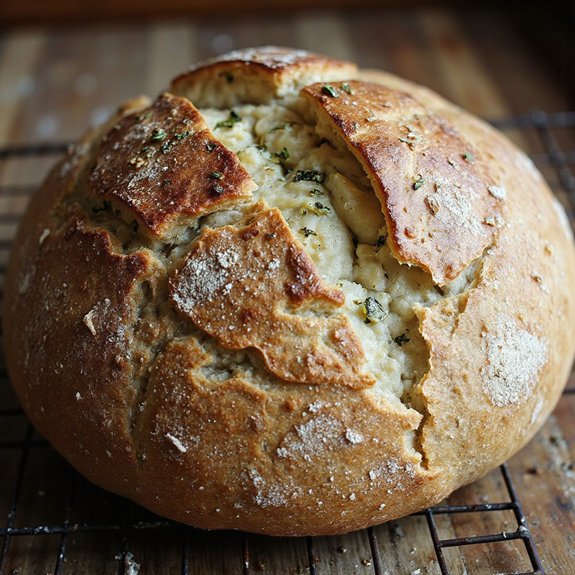
There’s something about pulling a blistered, golden loaf of garlic sourdough from the oven that makes the whole kitchen feel like home.
The crust crackles as it cools, deep brown and crisp, while ribbons of steam carry the warm aroma of roasted garlic and tangy fermented dough through the house.
This is comfort food at its best—perfect alongside a hearty stew, a simple salad, or a bowl of pasta—and it’s surprisingly hands-off, with slow rising doing most of the work.
It’s ideal for beginners ready to try sourdough, families who love fresh bread, and comfort seekers planning relaxed Sunday suppers or easy entertaining.
I still remember a rainy evening when a loaf of this bread, torn and shared with friends over soup, turned a gray day into something quietly special.
It’s also brilliant for meal-preppers; leftover slices toast beautifully all week.
Ready to bring this loaf to life?
Why You’ll Love It
- Delivers bold, aromatic garlic flavor in every chewy, tangy slice
- Elevates simple meals, from soups to salads, with bakery-quality bread
- Relies on a long, cold ferment for complex flavor and better digestibility
- Bakes in a Dutch oven for crackling crust and open crumb
- Freezes beautifully, so you can enjoy fresh-tasting slices anytime
Ingredients
- 100 g active sourdough starter — 100% hydration and very bubbly
- 350 g water — room temperature for easier mixing
- 450 g bread flour — unbleached for best gluten strength
- 50 g whole wheat flour — finely milled for better texture
- 10 g fine sea salt — helps strengthen gluten and flavor
- 25 g extra-virgin olive oil — adds richness and softness
- 30 g unsalted butter, melted — cool slightly before using
- 5 cloves garlic, finely minced — adjust up for stronger flavor
- 5 g garlic powder — boosts overall garlic aroma
- 5 g dried oregano, crumbled — rub between fingers to release oils
- 5 g dried parsley, crumbled — adds mild herbal freshness
- 10 g sugar or honey — lightly feeds fermentation and browning
- 10 g cornmeal or rice flour — for dusting banneton to prevent sticking
Step-by-Step Method
Mix Starter & Water
Whisk the active sourdough starter and room-temperature water in a large mixing bowl. Stir until the starter mostly dissolves and the liquid looks milky with only a few small bits remaining.
This helps distribute the natural yeast evenly, guaranteeing consistent fermentation and better rise throughout the dough later.
Combine Flours & Aromatics
Add the bread flour, whole wheat flour, sugar or honey, and garlic powder to the bowl. Mix with your hand or a dough scraper until no dry flour remains.
Scrape along the sides and bottom to incorporate everything. Aim for a shaggy, sticky dough with all ingredients hydrated and clumped together.
Autolyse the Dough
Cover the bowl with a lid, plate, or clean kitchen towel. Let the dough rest for 45–60 minutes at room temperature.
During this time, the flour hydrates and gluten begins forming on its own. This improves dough strength and makes later mixing and shaping easier, without overworking the dough.
Infuse the Garlic-Herb Butter
In a small bowl combine the melted butter, olive oil, minced garlic, dried oregano, and dried parsley. Stir until evenly mixed and let the mixture sit for 10 minutes.
This short rest allows the garlic and herbs to infuse the fats, so their flavor disperses more evenly in the final dough.
Incorporate Salt & Garlic Mixture
Sprinkle the salt evenly over the rested dough. Pour in the garlic-herb butter mixture.
Use your hand to pinch, squeeze, and fold the dough repeatedly until the fats and seasonings are fully incorporated. Continue until the dough looks uniform, with no visible pools of oil or streaks of butter.
Strengthen with Stretch-and-Folds
Cover the bowl and rest the dough for 30 minutes. Then perform a set of stretch-and-folds: grab one edge, stretch it upward, and fold it over the center.
Rotate the bowl and repeat 3–4 times. Do 3–4 total sets every 30 minutes over 1.5–2 hours, keeping the dough covered between sets.
Bulk Ferment Until Aerated
After the final folds, cover the bowl and let the dough bulk ferment at room temperature. Wait until it has increased by about 60–75% in volume and shows bubbles on the surface and sides.
This usually takes 3–6 hours depending on temperature. The dough should feel lighter, smoother, and slightly jiggly.
Pre-Shape the Dough
Lightly flour your work surface. Gently turn the dough out, trying not to deflate it completely.
Fold the edges of the dough toward the center, working around in a circle to form a rough ball. This loose pre-shape organizes gluten strands and makes the final shaping easier and more controlled.
Shape into a Tight Boule
Flip the dough so the seam faces down. Cup your hands around the dough and gently rotate it while pulling it toward you on the counter.
Use small, repeated movements to build surface tension without tearing the dough. Aim for a smooth, taut round boule that holds its shape well.
Prepare & Fill the Banneton
Generously dust a banneton or a medium bowl lined with a kitchen towel using cornmeal or rice flour. Make sure the sides and bottom are well coated to prevent sticking.
Place the shaped dough inside seam-side up. Adjust to center it. This orientation creates a natural opening pattern when baked.
Cold Proof in the Fridge
Cover the banneton or bowl with plastic wrap, a shower cap, or a towel. Refrigerate the dough for 8–12 hours.
This cold proof slows fermentation, deepens flavor, and firms the dough, making scoring easier. The dough should rise slightly and feel puffy yet still resilient when gently pressed.
Preheat Dutch Oven Thoroughly
Place your Dutch oven with its lid into your oven. Preheat to 475°F (245°C) for at least 30–40 minutes.
This long preheat guarantees the pot is fully heated, helping the loaf spring up quickly in the oven. The enclosed environment also traps steam for a crisp, well-developed crust.
Invert & Position the Dough
Remove the dough from the refrigerator. Cut a piece of parchment paper if using.
Carefully invert the dough onto the parchment or directly onto a lightly floured peel or board, seam-side down. Keep movements confident but gentle to avoid deflating the dough. Adjust to keep the loaf centered.
Score the Surface
Using a lame or very sharp knife, score the top of the dough with one or more cuts. Aim for a decisive, ¼-inch deep slash to control where the loaf expands.
Hold the blade at a slight angle for an ear, if desired. Proper scoring prevents random splitting and improves oven spring.
Load into the Dutch Oven
Wearing oven mitts, carefully remove the hot Dutch oven from the oven and take off the lid. Lift the dough by the parchment or slide it in from the peel.
Lower it gently into the pot. Replace the lid quickly to trap steam, and return the Dutch oven to the hot oven shelf.
Steam-Bake the Loaf
Bake the covered loaf at 475°F (245°C) for 20 minutes. The lid keeps steam inside, allowing the crust to stay supple while the bread rapidly expands.
Avoid opening the oven during this time. After 20 minutes, the loaf should have risen notably but still look pale.
Finish Baking Uncovered
Reduce the oven temperature to 450°F (230°C). Remove the Dutch oven lid carefully and continue baking the loaf uncovered for 18–22 minutes.
Watch for a deep golden-brown crust. Check that the internal temperature reaches 208–210°F (98–99°C) to ascertain the crumb is fully cooked.
Cool Fully Before Slicing
Use oven mitts to remove the finished loaf from the Dutch oven and place it directly on a wire cooling rack. Let it cool at least 1 hour before slicing.
This rest allows the crumb to set and moisture to redistribute, preventing a gummy texture and preserving the bread’s structure and flavor.
Ingredient Swaps
- Flours: Use all-purpose flour instead of bread flour (reduce water by ~10–20 g if dough feels too slack); swap whole wheat with spelt or rye for a earthier flavor.
- Dairy / Fat: For dairy-free, replace butter with equal weight olive oil or neutral oil; for richer flavor use browned butter instead of plain melted butter.
- Sweetener: Replace sugar with equal weight honey, maple syrup, or brown sugar.
- Garlic & Herbs: Use 2–3 tsp jarred minced garlic instead of fresh; swap oregano/parsley with Italian seasoning, thyme, or rosemary; omit garlic powder if needed and increase fresh garlic by 1–2 cloves.
- Dusting Flour: Use regular flour if you don’t have cornmeal or rice flour; semolina also works well for easy release.
You Must Know
– Avoid – To prevent a dense, tight crumb, don’t add extra flour during handling; instead lightly wet your hands and counter and keep total dough weight near 980–1,000 g; extra flour at shaping stiffens the dough and blocks the open, irregular holes sourdough is known for.
Serving Tips
- Serve warm slices with extra garlic butter or high-quality olive oil for dipping.
- Pair with tomato basil soup or hearty minestrone for a cozy, complete meal.
- Use as the base for open-faced mozzarella and tomato melts, broiled until bubbly.
- Slice thin for garlicky crostini topped with bruschetta or whipped ricotta.
- Accompany roasted chicken, grilled steak, or pasta with a basket of thick, warm slices.
Storage & Make-Ahead
Garlic sourdough keeps well at room temperature for 1–2 days, cut-side down on a board or loosely wrapped.
For make-ahead, slice and freeze up to 2 months in an airtight bag.
Reheat slices in a toaster or hot oven; avoid refrigerating, which dries the crumb.
Reheating
Reheat slices gently.
Wrap in foil and warm in a 300°F (150°C) oven.
Briefly toast in a covered skillet on low heat.
Or microwave 10–15 seconds with a damp towel.
Garlic Sourdough in Traditions
When I tear into a warm loaf of garlic sourdough, I’m always reminded that bread’s never just food—it’s a quiet thread running through so many family tables and cultural traditions.
I think about how every culture has its own way of honoring bread, then I slide this fragrant, garlicky loaf onto the table and watch it disappear.
In my family, garlic sourdough shows up at the in‑between moments: the night before a trip, a Sunday soup supper, the first cool evening of fall.
I’ve brought it to potlucks where it sat between samosas and tamales, soaking up sauces and stories. It feels like a little bridge—old‑world fermentation, familiar garlic comfort—inviting everyone to tear off a piece and belong.
Final Thoughts
Give this garlic sourdough a try and see how it transforms a simple loaf into something special.
Don’t hesitate to tweak the herbs, add extra garlic, or play with toppings so it becomes your own signature bread.
Frequently Asked Questions
Can I Make This Garlic Sourdough Completely Gluten-Free?
You can, but I wouldn’t just swap flours here. I’d use a dedicated gluten‑free sourdough starter, a tested gluten‑free loaf formula, then fold in the garlic‑herb butter, letting the dough feel soft, clingy, almost cake‑like.
How Do High Altitudes Affect Proofing and Baking Times?
They shorten both proofing and baking times; dough rises faster and dries quicker. I watch dough, not clocks—gentler fermentation, slightly lower oven temps, and vigilant peeks keep loaves tender, like baking on a bright, restless mountain morning.
What’s the Best Way to Rescue Over-Proofed Garlic Sourdough Dough?
I gently degas, reshape into a snug boule, then give it a short, cooler proof. If it still feels fragile, I turn it into garlic knots or focaccia, embracing its soft, airy temperament.
Can I Bake This Loaf Without a Dutch Oven or Specialized Equipment?
Yes, you can. I’d use a preheated baking stone or overturned sheet pan, then slide your loaf on, add a tray of hot water for steam, and watch the crust bloom like evening sunlight.
How Do I Adjust This Recipe for a Sourdough Starter With Different Hydration?
You’ll subtract or add water to match 100% hydration. If your starter’s 80%, add a little extra water; if it’s 125%, hold some back. I always adjust slowly, feeling for soft, billowy dough.
Garlic Sourdough Bread
Equipment
- 1 large mixing bowl
- 1 Medium bowl
- 1 Dough scraper
- 1 digital kitchen scale
- 1 measuring cup
- 3 Measuring spoons
- 1 Dutch oven with lid (4–5 quart)
- 1 banneton or 1 medium bowl lined with kitchen towel
- 1 lame or sharp knife
- 1 wire cooling rack
- 1 pastry brush (optional
Ingredients
- 100 gram active sourdough starter 100% hydration
- 350 gram water room temperature
- 450 gram bread flour unbleached
- 50 gram whole wheat flour fine
- 10 gram salt fine sea
- 25 gram olive oil extra-virgin
- 30 gram unsalted butter melted
- 5 clove garlic finely minced
- 5 gram garlic powder
- 5 gram dried oregano crumbled
- 5 gram dried parsley crumbled
- 10 gram sugar or honey
- 10 gram cornmeal or rice flour for dusting
Instructions
- In a large mixing bowl whisk together the active sourdough starter and water until mostly dissolved.
- Add bread flour, whole wheat flour, sugar or honey, and garlic powder to the bowl and mix with your hand or a dough scraper until no dry flour remains.
- Cover the bowl and let the dough rest (autolyse) at room temperature for 45–60 minutes.
- In a small bowl combine melted butter, olive oil, minced garlic, dried oregano, and dried parsley and let sit for 10 minutes.
- Sprinkle salt over the rested dough, pour in the garlic-herb butter mixture, and pinch and fold the dough until everything is evenly incorporated.
- Perform 3–4 sets of stretch-and-folds every 30 minutes over 1.5–2 hours, keeping the dough covered between sets.
- After the final set of folds, cover the bowl and allow the dough to bulk ferment at room temperature until increased by about 60–75% and showing bubbles, 3–6 hours depending on temperature.
- Lightly flour your work surface, gently turn the dough out, and shape it into a rough round by folding the edges toward the center.
- Flip the dough seam-side down and tighten it into a boule by rotating and pulling it toward you on the counter.
- Generously dust a banneton or towel-lined bowl with cornmeal or rice flour and place the dough seam-side up inside.
- Cover and refrigerate the dough for 8–12 hours for a cold proof.
- Place the Dutch oven with its lid into your oven and preheat to 475°F (245°C) for at least 30–40 minutes.
- Remove the dough from the refrigerator, cut a piece of parchment if desired, and carefully invert the dough onto the parchment or directly onto a lightly floured peel or board seam-side down.
- Score the top of the dough with a lame or sharp knife to allow controlled expansion during baking.
- Carefully transfer the dough into the preheated Dutch oven, cover with the lid, and place it back in the oven.
- Bake covered for 20 minutes at 475°F (245°C).
- Reduce the temperature to 450°F (230°C), remove the lid, and continue baking for 18–22 minutes until the crust is deep golden-brown and the internal temperature reaches about 208–210°F (98–99°C).
- Remove the bread from the Dutch oven and place it on a wire rack to cool completely for at least 1 hour before slicing.
Notes

Cynthia Weatherford is a seasoned chef and culinary enthusiast who serves as the Recipe creator of Somonday. With decades of experience in the kitchen and a passion for exploring diverse cuisines, Cynthia brings a blend of creativity and technique to every dish. Known for transforming simple ingredients into show-stopping meals, Cynthia believes that cooking is an art form anyone can master. Dedicated to inspiring home cooks, Cynthia shares approachable recipes, pro tips, and culinary wisdom to make every meal memorable.