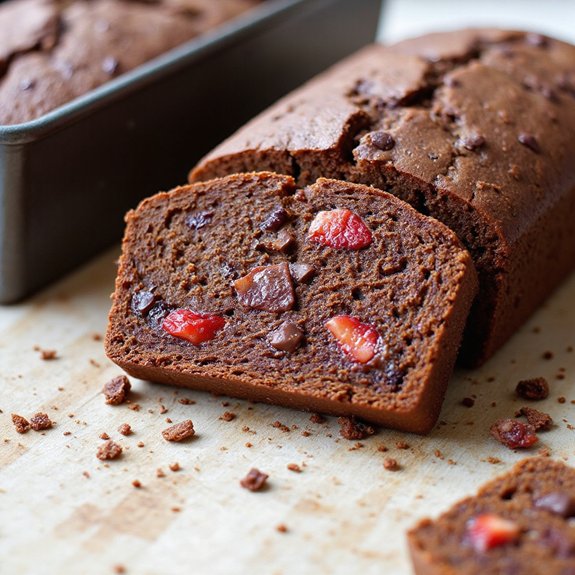
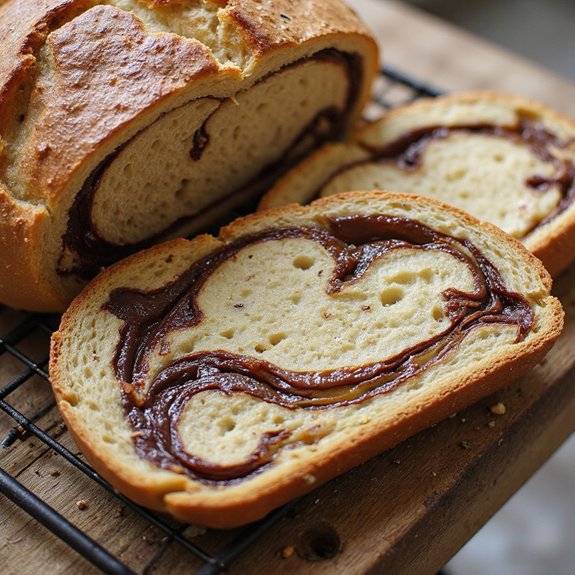
There’s something about tearing into a still-warm loaf, glossy swirls of chocolate-hazelnut peeking through a burnished sourdough crust, that feels like pure comfort.
This Nutella sourdough bread is a cozy, bakery-style treat—part breakfast loaf, part dessert—built on a tangy, chewy crumb with ribbons of melted Nutella in every slice.
It’s not instant, but most of the time is hands-off, making it perfect for relaxed weekends or slow Sunday baking.
It’s ideal for sweet-tooth fans, families, and anyone who loves the ritual of sourdough but wants something a little more playful.
I first leaned on this recipe during a gray winter weekend when everyone at home needed a pick-me-up; a few thick slices, still warm, turned a quiet afternoon into an impromptu treat break.
This loaf shines for brunch tables, cozy evening desserts, or as a thoughtful edible gift. Ready to bring this loaf to life?
Why You’ll Love It
- Delivers rich, chocolate-hazelnut swirls in a tangy sourdough loaf
- Elevates simple pantry ingredients into an impressive bakery-style dessert bread
- Balances indulgent Nutella sweetness with a complex, fermented flavor profile
- Slices beautifully for breakfast, brunch boards, or sweet snack platters
- Keeps well and reheats perfectly for days of treat-yourself toast
Ingredients
- 100 g active sourdough starter, 100% hydration — use bubbly, recently fed starter
- 320 g water, room temperature — cooler side helps manage fermentation
- 430 g bread flour — higher protein for good structure and chew
- 50 g whole wheat flour — adds flavor and a nuttier aroma
- 9 g fine sea salt — balances sweetness and strengthens dough
- 120 g Nutella, at room temperature — soft enough to spread without tearing dough
- 10 g unsalted butter, melted (optional) — brush on crust for a softer, glossy finish
- 10 g all-purpose flour, for dusting — light coating to prevent sticking during shaping
Step-by-Step Method
Feed and test your starter
Use an active 100% hydration starter that has recently peaked. Feed it 4–8 hours before mixing.
Check readiness by dropping a spoonful into water; it should float. Make sure it smells pleasantly tangy, not harsh. A strong starter is vital to lift this enriched, Nutella-filled dough and prevent a dense loaf.
Mix starter and water
Combine the active starter and room-temperature water in a large bowl. Whisk until the starter mostly dissolves.
Aim for an even, milky mixture with no thick clumps. Properly dispersing the starter guarantees even fermentation later and helps the flour hydrate more uniformly during the next mixing step.
Hydrate the flours
Add bread flour and whole wheat flour to the bowl. Mix with a wooden spoon or spatula until no dry spots remain.
Scrape the sides and bottom to incorporate all flour. Expect a shaggy, sticky mass, not a smooth dough yet. Cover the bowl to prevent drying before resting.
Rest for autolyse
Let the covered dough rest for 45–60 minutes at room temperature. Don’t add salt yet.
Allow the flour to fully hydrate and gluten to begin developing on its own. This rest improves extensibility and flavor. Keep the bowl in a draft-free spot, away from direct heat or sunlight.
Incorporate the salt
Sprinkle the fine sea salt evenly over the dough. Use your hands to pinch, fold, and squeeze the dough until the salt disappears.
Wet your fingers lightly if sticking is an issue. Continue until the dough feels more cohesive. Make sure there are no gritty salt pockets left in the mixture.
Begin stretch-and-folds
Let the dough rest 30 minutes after adding salt. Then perform the first set of stretch-and-folds.
Grab one edge, stretch it up gently, and fold over the center. Rotate the bowl and repeat on all four sides. Cover again. This strengthens gluten without kneading on the counter.
Continue strengthening the dough
Repeat stretch-and-folds every 30 minutes for a total of four sets over about two hours. Notice the dough becoming smoother, more elastic, and slightly less sticky after each set.
Handle it gently to avoid tearing. Keep the bowl covered between sets to retain moisture and warmth.
Bulk ferment until puffy
After the final fold, cover the bowl and let the dough rise at room temperature. Watch for it to become roughly doubled, airy, and domed, usually 3–5 hours.
Look for visible bubbles along the sides. Adjust time based on temperature; warmer kitchens ferment faster, cooler ones slower.
Prepare the work surface
Lightly flour your counter with all-purpose flour. Avoid using too much flour, which can toughen the dough.
Gently loosen the dough from the bowl using a dough scraper. Turn it out onto the floured surface, trying not to deflate it completely, preserving gas for a lighter crumb.
Shape into a rectangle
Gently pat the dough into a loose rectangle with your fingertips. Avoid pressing too hard or squeezing out all the air.
Aim for an even thickness throughout. This shape sets you up for an even Nutella layer and a tight roll later. Dust lightly with flour only if sticking.
Spread the Nutella
Make sure Nutella is at room temperature for easy spreading. Use an offset spatula or spoon to gently spread it over the dough surface.
Leave a small clean border around all edges to help sealing. Spread evenly without tearing the dough. Keep the layer moderate to avoid excessive leaking.
Roll into a tight log
Start rolling from a short side for a taller loaf. Roll the dough snugly but not so tight that it tears.
Gently tuck Nutella inside as you go. Seal the final edge by pinching lightly. This log shape helps create distinct swirls and reduces the risk of the filling escaping.
Coil or shape the loaf
Coil the log into a loose spiral or fold it into a bâtard-style loaf. Tuck the ends under to keep Nutella enclosed.
Use your hands to gently tighten the shape without squeezing out filling. Aim for an even thickness so the loaf bakes uniformly and rises predictably in the oven.
Prepare the proofing basket
Lightly flour your banneton or a medium bowl lined with a clean towel. Use all-purpose or rice flour to help prevent sticking.
Shake out any excess. This flour barrier is especially important with a filled dough, which can be slightly stickier and more prone to catching on the cloth.
Place dough seam-side up
Transfer the shaped dough gently into the prepared basket, seam-side up. Support it with both hands to avoid stretching.
Let it nestle in the basket so the sides are supported. This orientation allows the seam to help with structure and makes flipping later easier for scoring and baking.
Cold proof overnight
Cover the basket tightly with plastic wrap or a reusable cover. Refrigerate for 8–12 hours.
This slow, cold proof develops deeper flavor and firms the dough, making it easier to handle. It also helps the Nutella set slightly, so it stays in place and swirls more cleanly when sliced.
Preheat the Dutch oven
About 45 minutes before baking, place your Dutch oven with its lid into the oven. Preheat to 475°F (245°C).
Allow enough time for the pot and oven to fully heat. A thoroughly preheated vessel gives a strong initial burst of steam and oven spring, improving crust and rise.
Invert the loaf onto parchment
Remove the dough from the refrigerator. Lay a sheet of parchment over the basket. Invert the basket so the loaf flips onto the parchment, now seam-side down.
Gently lift off the basket. Adjust the parchment so there’s enough excess around the dough for easy lifting into the pot.
Score the dough
Use a sharp lame or knife to score the top of the loaf. Make a confident, swift slash about ¼ inch deep along the length or in your preferred pattern.
Scoring controls expansion and prevents random tearing. Avoid cutting so deep that Nutella spills from the surface areas.
Load into the hot Dutch oven
Carefully lift the parchment with the dough and lower it into the preheated Dutch oven. Keep fingers and arms away from hot surfaces.
Cover immediately with the lid to trap steam. This enclosed environment supports maximum oven spring and helps the crust form evenly without drying prematurely.
Steam-bake, then uncover
Bake covered for 20 minutes at 475°F (245°C). Then reduce the oven temperature to 450°F (230°C) and remove the lid.
Continue baking an additional 15 minutes. Watch the crust color; it should become deeply golden-brown. Tent loosely with foil if it darkens too quickly while finishing.
Brush with butter (optional)
Once baked, remove the loaf from the Dutch oven and place on a cooling rack. If desired, brush the hot crust lightly with melted unsalted butter.
Use a pastry brush for an even, thin coat. This step softens the crust slightly and adds a glossy, enriched finish that complements Nutella.
Cool completely before slicing
Let the bread cool on the rack for at least 1–2 hours. Resist slicing early, as the interior will be gummy and the Nutella may smear.
Cooling allows the crumb to set and swirls to firm. Once fully cooled, slice with a sharp serrated knife for clean, defined Nutella ribbons.
Ingredient Swaps
- Use any active 100% hydration starter (white, whole wheat, or rye); if using a stiffer starter, add a bit more water to the dough.
- Substitute bread flour with strong all-purpose flour if needed; swap whole wheat with spelt or rye for a heartier flavor (you may need 10–20 g extra water).
- Replace Nutella with another chocolate-hazelnut spread, peanut butter + chocolate chips, or a dairy-free cocoa spread for a vegan option.
- For dairy-free, skip the butter finish and make certain your spread is vegan; for nut-free, use a chocolate-only spread or thick chocolate ganache instead of Nutella.
You Must Know
– Flavor Boost • For deeper chocolate-hazelnut notes: Swap 20–30 g of the bread flour for cocoa powder and lightly toast 10–20 g chopped hazelnuts (in a pan until fragrant, 3–5 minutes) to sprinkle over the Nutella layer.
This sharpens the chocolate flavor and adds crunch without making the crumb heavy.
Serving Tips
- Serve slightly warm slices with a light dusting of powdered sugar.
- Pair with fresh berries and a dollop of whipped cream or mascarpone.
- Toast leftovers and top with sliced bananas and a drizzle of honey.
- Plate alongside espresso or strong coffee for a rich dessert-style breakfast.
- Make mini dessert toasts with crushed hazelnuts and a pinch of flaky salt.
Storage & Make-Ahead
Nutella sourdough keeps in the fridge for 4–5 days, well wrapped to prevent drying and fridge odors.
For make-ahead, bake, cool completely, then freeze whole or sliced (separated by parchment) for up to 2 months.
Thaw at room temperature and refresh briefly in a warm oven if desired.
Reheating
Reheat slices gently: in a 300°F (150°C) oven for 8–10 minutes.
In a covered skillet on low heat.
Or briefly in the microwave at 50% power to avoid drying.
Nutella Bread Traditions Worldwide
Often, a slice of chocolate-streaked bread on the table says as much about where we’re as what we’re eating. When I tear into warm Nutella sourdough, I picture Italian breakfasts—thick slices, sunlight on tiled floors, espresso scent rising nearby.
In France, I imagine a baguette split open, Nutella swirled along the crumb, crinkling paper bag under my elbow. In Germany, I think of dense breakfast bread, Nutella melting into hearty slices beside strong coffee.
At home, I borrow from all of them: a rustic boule on a wooden board, knife marks in the crust, Nutella ribbons glistening as they cool. Wherever you’re reading this, a Nutella-laced loaf can quietly echo those shared, chocolatey mornings.
Final Thoughts
Give this Nutella Sourdough Bread a try and enjoy the mix of tangy sourdough with rich, chocolate-hazelnut swirls.
Don’t hesitate to tweak the filling or flours to make it your own signature loaf.
Frequently Asked Questions
Can I Make This Nutella Sourdough Completely Vegan Without Sacrificing Texture?
Yes, you can. I’d swap Nutella for a rich vegan hazelnut spread and brush the crust with oat milk. The loaf still rises tall, crackles warmly, and smells like toasted nuts and cocoa at dawn.
How Can I Adjust Fermentation for High-Altitude or Very Humid Environments?
You’ll shorten bulk fermentation at altitude, lengthen it in humidity. I watch the dough, not the clock—aim for soft, airy puff. Cooler rooms, tighter lids, and lightly floured baskets keep everything billowy, not sticky.
Is It Safe to Freeze the Dough Before the Nutella Swirl Is Added?
Yes, you can freeze the dough before adding the swirl. I’d shape it into a soft, round cushion, wrap it snugly, then thaw overnight in the fridge until supple and slightly puffy before continuing.
What Troubleshooting Steps Help if My Loaf Consistently Bakes up Dense?
I’d first lengthen bulk fermentation until the dough feels airy and jiggly, then check my starter’s strength. I’d gently handle shaping, watch proofing closely, and bake fully for a crackling crust and tender, steamy crumb.
How Do I Scale This Recipe for a Bakery or Small Commercial Production?
You’ll scale by baker’s percentages: convert everything to percentages of total flour, then multiply for your desired dough weight. I’d test a 5× batch first, adjusting fermentation, proofing space, and oven load by observation.
Nutella Sourdough Bread
Equipment
- 1 large mixing bowl
- 1 medium mixing bowl
- 1 digital kitchen scale
- 1 Dough scraper
- 1 wooden spoon or silicone spatula
- 1 bench scraper
- 1 proofing basket (banneton) or 1 medium bowl with towel
- 1 Dutch oven with lid (4–5 qt) or 1 heavy oven-safe pot with lid
- 1 sheet of parchment paper
- 1 sharp scoring knife or lame
- 1 pastry brush (optional
- 1 Cooling rack
Ingredients
- 100 gram active sourdough starter 100% hydration
- 320 gram water room temperature
- 430 gram bread flour
- 50 gram whole wheat flour
- 9 gram fine sea salt
- 120 gram Nutella at room temperature
- 10 gram unsalted butter optional, for brushing; melted
- 10 gram all-purpose flour for dusting
Instructions
- In a large mixing bowl whisk together the active sourdough starter and water until mostly dissolved.
- Add the bread flour and whole wheat flour to the bowl and mix with a spoon or spatula until no dry spots remain and a shaggy dough forms.
- Cover the bowl and let the dough rest (autolyse) at room temperature for 45–60 minutes.
- Sprinkle the salt over the dough and use your hands to pinch, fold, and squeeze the dough until the salt is fully incorporated.
- Perform a series of 4 stretch-and-folds every 30 minutes over 2 hours, keeping the dough covered between sets, until it becomes smoother and more elastic.
- After the final fold, cover the bowl and let the dough bulk ferment at room temperature until roughly doubled and puffy, about 3–5 hours depending on room temperature.
- Lightly flour your work surface, gently turn the dough out, and pat it into a rectangle without deflating it completely.
- Gently spread the Nutella evenly over the surface of the dough, leaving a small border around the edges.
- Starting from a short side, roll the dough up into a tight log, then coil or fold it into your desired loaf shape, keeping as much Nutella inside as possible.
- Lightly flour your proofing basket or towel-lined bowl and place the shaped dough seam-side up inside.
- Cover the basket tightly and refrigerate the dough for a cold final proof of 8–12 hours.
- About 45 minutes before baking, place the Dutch oven with its lid into the oven and preheat to 475°F (245°C).
- Remove the dough from the refrigerator, place a sheet of parchment over the basket, and invert the loaf onto the parchment seam-side down.
- Score the top of the dough with a sharp knife or lame to allow for controlled expansion in the oven.
- Carefully lower the parchment with the dough into the preheated Dutch oven, cover with the lid, and place it back into the oven.
- Bake covered for 20 minutes, then reduce the temperature to 450°F (230°C), remove the lid, and bake for an additional 15 minutes or until deeply golden-brown.
- Optionally brush the hot crust lightly with melted butter for a softer, glossy finish.
- Transfer the loaf to a cooling rack and let it cool completely, at least 1–2 hours, before slicing to avoid a gummy interior.
Notes

Cynthia Weatherford is a seasoned chef and culinary enthusiast who serves as the Recipe creator of Somonday. With decades of experience in the kitchen and a passion for exploring diverse cuisines, Cynthia brings a blend of creativity and technique to every dish. Known for transforming simple ingredients into show-stopping meals, Cynthia believes that cooking is an art form anyone can master. Dedicated to inspiring home cooks, Cynthia shares approachable recipes, pro tips, and culinary wisdom to make every meal memorable.