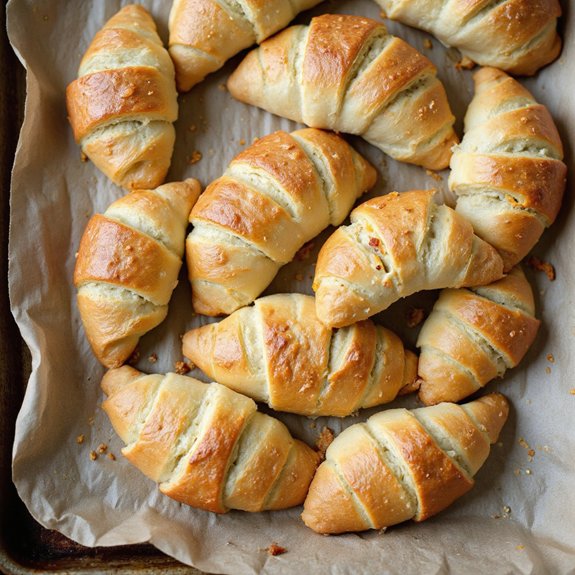
There’s something about a tray of golden, spiraled rolls emerging from the oven—their crisp, flaky edges giving way to soft, cloud-like centers—that makes the whole kitchen feel warmer.
These sourdough crescent rolls are pure cozy baking: buttery, gently tangy, and tender enough to pull apart in feathery layers.
They’re perfect for comforting dinners, holiday spreads, or anytime you want a homemade bread basket that feels special without being fussy.
While they take some rise time, the hands-on work is surprisingly simple, making them ideal for beginners and anyone easing into sourdough.
I still remember a gloomy Sunday when friends dropped by unexpectedly.
I shaped a batch of these crescents from dough I’d prepped the night before; an hour later, we were tearing into warm rolls, passing butter and jam, and lingering long after the rain stopped.
They shine at family dinners, potlucks, or slow Sunday suppers. Ready to bring this recipe to life?
Why You’ll Love It
- Delivers rich, buttery flavor with a subtle sourdough tang in every bite
- Creates feather-light, pull-apart layers that stay soft and tender for days
- Uses simple pantry ingredients plus starter—no specialty flours or tools required
- Adapts to your schedule with optional yeast and overnight fridge rise
- Doubles as savory or sweet rolls with easy filling and topping swaps
Ingredients
- 120 g sourdough starter, active and bubbly — well-fed for best rise
- 240 ml whole milk, warm (about 38°C) — gently warmed, not hot
- 50 g granulated sugar — just enough for tenderness and browning
- 1 large egg, room temperature — takes the chill off for better mixing
- 75 g unsalted butter, melted and cooled — cool so it doesn’t cook the egg
- 500 g all-purpose flour — standard protein level works best
- 9 g fine sea salt — dissolves evenly in the dough
- 7 g instant yeast (optional) — add only if you want a faster rise
- 30 g unsalted butter, softened — for spreading over rolled-out dough
- 1 large egg, beaten — for shiny, golden egg wash
- 15 ml water — to thin egg for an easy-to-brush wash
Step-by-Step Method
Mix the wet ingredients
Whisk the warm milk, active sourdough starter, sugar, egg, and melted cooled butter in a large bowl. Blend until smooth with no streaks of egg or starter.
Make sure the milk is warm, not hot, to avoid killing the starter or curdling the egg. Set aside briefly while you prepare the dry ingredients.
Combine the dry ingredients
In a separate large bowl, add the flour, fine sea salt, and instant yeast if using. Whisk or stir thoroughly to distribute the salt and yeast evenly throughout the flour.
Breaking up any lumps now helps create a smoother dough later. This step prevents pockets of salt or yeast from forming in the final dough.
Bring dough together
Pour the dry mixture into the wet ingredients. Stir with a spatula until a shaggy dough forms and all flour is moistened.
Scrape down the sides and bottom of the bowl to incorporate stray bits. The dough will look rough and slightly sticky at this stage, which is exactly what you want before kneading.
Knead until smooth and elastic
Transfer the dough to a lightly floured surface or attach the dough hook to your stand mixer. Knead by hand for 8–10 minutes or in the mixer on medium-low for 5–6 minutes.
Aim for a smooth, elastic, and slightly tacky dough. Add minimal extra flour, only dusting lightly if it sticks excessively.
Let the dough rise
Shape the dough into a smooth ball. Lightly oil a clean bowl and place the dough inside, turning once to coat.
Cover with a clean towel or plastic wrap. Let it rise at room temperature until doubled in size, about 2–3 hours. Adjust timing based on your kitchen temperature and starter strength.
Deflate and prepare to roll
Gently punch down or press the risen dough to release excess gas. Turn it out onto a lightly floured work surface.
Avoid tearing the dough as you handle it. Pat it into a rough disk. Add a light dusting of flour if needed, keeping the dough soft rather than stiff to maintain tender rolls.
Roll into a large circle
Use a rolling pin to roll the dough into a large circle about 30–35 cm in diameter. Aim for an even thickness of 0.5–0.75 cm across the entire round.
Rotate the dough frequently and dust lightly with flour as needed to prevent sticking. Keep edges relatively even for uniform crescent sizes.
Spread softened butter
Take the 30 g of softened butter and spread it evenly over the entire surface of the rolled dough. Use an offset spatula or the back of a spoon.
Leave a tiny bare border at the very edge if needed to reduce seepage. Make certain a thin, uniform layer so each roll bakes rich and tender.
Cut into wedges
With a sharp knife or pizza cutter, slice the circle into 12 equal wedges, like cutting a pizza. Start by cutting in half, then quarters, and finally each quarter into three wedges for even pieces.
Try to keep the center point neat. Clean the blade occasionally for smoother cuts.
Roll into crescents
Working with one wedge at a time, gently stretch the wide base slightly to lengthen it. Starting from the wide end, roll the dough toward the pointed tip, keeping the roll snug but not overly tight.
Curve the ends slightly inward to create a crescent shape. Repeat with remaining wedges.
Arrange and proof the rolls
Place each shaped crescent tip-side down on parchment-lined baking sheets, spacing them a few centimeters apart for expansion. Cover loosely with a towel or plastic wrap.
Let them rise at room temperature until puffy and nearly doubled, about 45–60 minutes. They should look lighter and jiggle slightly when nudged.
Preheat the oven
Near the end of the proofing time, preheat your oven to 190°C. Position racks in the upper and lower thirds to promote even baking.
Make certain the oven is fully preheated before the rolls go in. This helps them rise properly in the oven and develop a nicely browned, tender crust.
Prepare the egg wash
In a small bowl, whisk together one beaten egg with 15 ml of water until completely smooth. Break up any streaks of yolk or white.
This thinned egg wash creates a glossy, golden finish. Keep the mixture nearby with a pastry brush, ready to apply just before the rolls go into the oven.
Brush and bake
Lightly brush the tops of the proofed crescents with the egg wash, avoiding excessive pooling around the base. Place the baking sheets on the prepared oven racks.
Bake for 16–18 minutes, rotating the pans halfway through for even browning. Remove when the rolls are golden brown and cooked through.
Cool briefly and serve
Transfer the baked rolls to a cooling rack or leave them on the baking sheets. Let them cool for 5–10 minutes so the crumb sets and they’re easier to handle.
Serve warm for the best texture and flavor. Optionally brush with melted butter right after baking for extra softness and sheen.
Ingredient Swaps
- Milk: Use 240 ml oat, soy, or almond milk for dairy-free; or 2% milk if that’s what you have (a bit less rich, still works well).
- Butter (in dough & for spreading): Swap with vegan butter or refined coconut oil for dairy-free; salted butter is fine—just reduce added salt by ~1–2 g.
- Egg (in dough): Replace with 45–60 ml unsweetened applesauce, plain yogurt, or a commercial egg replacer for an egg-free version.
- Flour: Bread flour can replace all-purpose (expect slightly chewier rolls; you may need 1–2 tsp more milk).
Up to 25–30% whole wheat flour can be used; increase milk slightly if dough feels stiff.
- Sugar: Any granulated sweetener (cane, beet, light brown, or coconut sugar) works; for less refined options, use coconut sugar or a mild honey/maple syrup and slightly reduce the milk.
- Instant yeast: Omit entirely for a fully wild-yeast dough—just extend both rise times, sometimes up to double.
You Must Know
– Doneness • If the rolls brown too fast in the oven
Tent loosely with foil at about 10–12 minutes and keep baking until the sides (not just tops) are a deep golden and feel light when lifted. This keeps the centers from being doughy while preventing over-dark crust.
– Troubleshoot • If the dough feels dense and stiff after combining
Work in 5–10 ml warm milk at a time until it’s soft and slightly tacky. A supple dough traps gas better, giving you lighter layers instead of tight, bready crescents.
– Avoid • If the dough has barely risen after 3 hours
Don’t move on; give it more time until it’s visibly doubled and airy, even if it takes 4–6 hours without instant yeast. Under-proofing is the main cause of tight, heavy rolls.
– Make-Ahead • For overnight fridge proofing after shaping
Chill the tray covered for up to 16 hours, then let the crescents warm at room temp 45–90 minutes until noticeably puffy before egg wash. Cold dough bakes up dense if it doesn’t finish proofing.
– Flavor Boost • To get more tangy sourdough character
Reduce instant yeast to 0–2 g or omit it, and let the first rise go closer to 4–5 hours at cool room temp (around 21°C). A slower rise gives a more complex, buttery-sour flavor without extra ingredients.
Serving Tips
- Serve warm with salted butter, honey, or homemade jam for breakfast or brunch.
- Pair alongside roasted chicken, turkey, or ham as a tender, buttery dinner roll.
- Split and fill with sliced cheese and ham for mini crescent sandwiches.
- Plate in a bread basket lined with a towel to keep them warm.
- Brush with garlic-herb butter and serve beside soup, stew, or pasta.
Storage & Make-Ahead
Store baked sourdough crescent rolls in an airtight container in the fridge for up to 4 days.
Rewarm gently to refresh.
For make-ahead, shape and refrigerate overnight.
Then proof and bake.
Fully baked, cooled rolls freeze well for about 2 months.
Thaw at room temperature, then warm before serving.
Reheating
Reheat rolls gently: in a 150°C oven, covered with foil, 8–10 minutes.
In microwave, wrapped in a damp towel, 10–20 seconds.
Or on stovetop, covered skillet on low until warmed through.
Holiday and Family Traditions
Some of my favorite holiday memories start with the quiet sound of dough being rolled out and the warm, buttery scent of sourdough crescent rolls filling the kitchen.
While the house wakes up slowly, I’m there with flour on my hands, stretching each triangle, rolling it into a tight little scroll of promise.
I love how these rolls gather everyone without a word. Someone steals the first one, too hot to hold, tearing it open so steam curls into the air.
Butter melts into the flaky layers, and suddenly the room softens—voices drop, shoulders relax.
When you bake them for your own celebrations, you’re not just making bread. You’re building a ritual people will quietly look forward to every year.
Final Thoughts
Give these Sourdough Crescent Rolls a try and enjoy their soft, buttery, tangy goodness fresh from your own oven.
Don’t hesitate to tweak the sweetness, tang, or size of the rolls to make the recipe perfectly yours.
Frequently Asked Questions
Can I Make These Crescent Rolls Completely Vegan Without Eggs or Dairy?
Yes, you can. I’d swap in oat or soy milk, vegan butter, and flax “eggs” for binding. You’ll still pull apart warm, tender rolls, steam rising, with that rich, buttery aroma—just entirely, deliciously plant-based.
How Do I Adjust This Recipe for High-Altitude Baking Conditions?
You’ll tweak three things: reduce yeast slightly, hold back 1–2 tablespoons milk, and bake a bit hotter/shorter. At altitude, dough rises faster—watch for soft, billowy texture rather than the clock, like clouds swelling before sunrise.
What’s the Best Way to Freeze the Unbaked Shaped Crescent Rolls?
You’ll freeze them after shaping and a short chill on the tray, then bag airtight. I’d bake from frozen, adding 10–15 minutes, smelling butter bloom while their frosted edges slowly swell into golden, tender layers.
How Can I Make the Dough in Advance and Bake Over Several Days?
You can mix and bulk‑ferment, then chill the dough overnight. Each day, I’d cut off what you need, roll and shape, proof until billowy, then bake—so your kitchen smells like fresh buttered clouds daily.
Are There Sweet or Savory Filling Variations That Won’T Affect the Dough Structure?
You can tuck in thin layers of chocolate, jam, cinnamon sugar, cheese, or herb butter without hurting structure. I keep fillings soft, not chunky, and spread sparingly so the spirals stay tight and tender.

Sourdough Crescent Rolls
Equipment
- 1 stand mixer with dough hook (optional but recommended)
- 2 large mixing bowls
- 1 Small bowl
- 1 Whisk
- 1 Rubber spatula
- 1 Rolling Pin
- 2 baking sheets
- 2 sheets parchment paper
- 1 pastry brush
- 1 kitchen scale (optional)
- 1 clean kitchen towel or plastic wrap
Ingredients
- 120 gram sourdough starter active and bubbly
- 240 milliliter whole milk warm about 38°C
- 50 gram granulated sugar
- 1 large egg room temperature
- 75 gram unsalted butter melted and cooled
- 500 gram all-purpose flour plus extra for dusting
- 9 gram fine sea salt
- 7 gram instant yeast optional for faster rise
- 30 gram unsalted butter softened for spreading on dough
- 1 large egg beaten for egg wash
- 15 milliliter water for thinning egg wash
Instructions
- In a large mixing bowl, whisk together the warm milk, sourdough starter, sugar, egg, and melted cooled butter until smooth.
- In a separate bowl, combine the flour, salt, and instant yeast (if using) and mix to distribute evenly.
- Add the dry mixture to the wet ingredients and stir with a spatula until a shaggy dough forms.
- Knead the dough by hand for 8–10 minutes or in a stand mixer on medium-low speed for 5–6 minutes until smooth, elastic, and slightly tacky.
- Shape the dough into a ball, place it in a lightly oiled bowl, cover with a towel or plastic wrap, and let rise at room temperature until doubled, about 2–3 hours.
- Gently deflate the risen dough and turn it out onto a lightly floured work surface.
- Roll the dough into a large circle about 30–35 cm in diameter and 0.5–0.75 cm thick.
- Spread the softened butter evenly over the surface of the rolled-out dough.
- Using a sharp knife or pizza cutter, cut the circle into 12 equal wedges like a pizza.
- Working one wedge at a time, gently stretch the wide end, then roll it up tightly toward the pointed tip to form a crescent shape.
- Place each rolled crescent tip-side down on a parchment-lined baking sheet, spacing them a few centimeters apart.
- Cover the shaped rolls loosely with a towel or plastic wrap and let rise at room temperature until puffy and nearly doubled, about 45–60 minutes.
- Near the end of the rise, preheat the oven to 190°C and position racks in the upper and lower thirds.
- In a small bowl, whisk together the egg and water to make an egg wash.
- Brush the tops of the proofed crescent rolls lightly and evenly with the egg wash.
- Bake the rolls for 16–18 minutes, rotating the pans halfway, until golden brown and cooked through.
- Remove the rolls from the oven and let cool on the baking sheets for 5–10 minutes before serving warm.
Notes

Cynthia Weatherford is a seasoned chef and culinary enthusiast who serves as the Recipe creator of Somonday. With decades of experience in the kitchen and a passion for exploring diverse cuisines, Cynthia brings a blend of creativity and technique to every dish. Known for transforming simple ingredients into show-stopping meals, Cynthia believes that cooking is an art form anyone can master. Dedicated to inspiring home cooks, Cynthia shares approachable recipes, pro tips, and culinary wisdom to make every meal memorable.