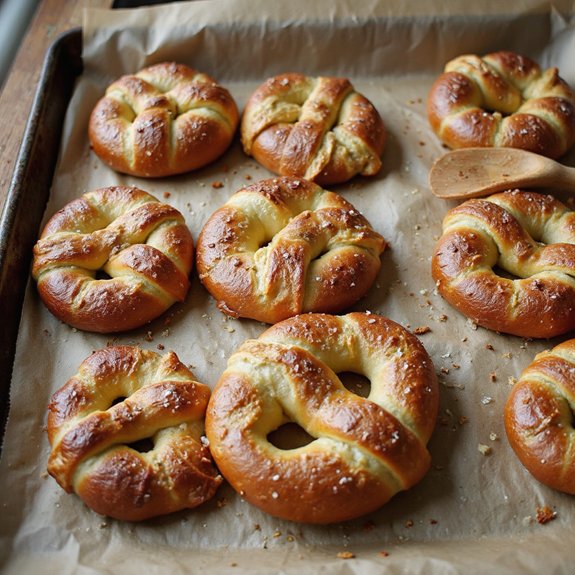
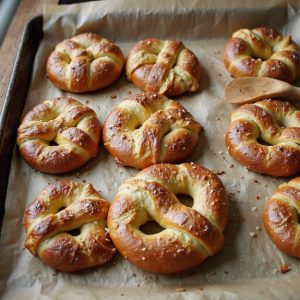
There’s something about a tray of freshly baked pretzels—deep golden brown, blistered in spots, and showered with coarse salt—that makes the whole kitchen feel like a cozy bakery.
These sourdough discard soft pretzels are everything you want in a snack: chewy outside, pillowy inside, with that subtle tang that only sourdough can give.
They’re quick enough for an afternoon craving, ready in about an hour, and simple enough for beginners or busy parents baking with kids.
I started making these during a stretch of long workdays, when my sourdough starter was overflowing with discard and my energy was running low.
Twisting dough into pretzel shapes became a small ritual that reset my mood and turned leftover starter into something special for movie night.
They’re perfect for game days, casual gatherings, or a last-minute warm treat on a chilly evening.
Ready to bring this recipe to life?
Why You’ll Love It
- Uses sourdough discard, reducing food waste in a delicious way
- Delivers classic pretzel chew with a soft, fluffy interior
- Comes together quickly with a boost from instant yeast
- Uses simple pantry ingredients and basic kitchen equipment
- Freezes beautifully for easy snacks anytime
Ingredients
- 240 g sourdough discard, unfed, 100% hydration — use flavorful, recently refreshed starter
- 240 g all-purpose flour — standard protein (10–11%) for tenderness
- 120 g bread flour — boosts chew and structure
- 10 g granulated sugar — balances tang and supports browning
- 8 g fine sea salt — seasons dough evenly
- 6 g instant yeast — guarantees reliable rise alongside discard
- 30 g unsalted butter, melted and slightly cooled — enriches crumb and flavor
- 180 g warm water (about 40°C) — comfortably warm to activate yeast
- 2 L water — for the boiling soda bath
- 60 g baking soda — creates classic pretzel color and flavor
- 1 large egg — for shiny, deeply golden crust
- 15 g water — thins egg wash for easy brushing
- 10 g coarse salt — classic pretzel topping with crunchy bite
Step-by-Step Method
Mix the Dry Ingredients
Whisk together the all-purpose flour, bread flour, sugar, salt, and instant yeast in a large mixing bowl.
Distribute everything evenly so the yeast and salt are well dispersed.
This helps the dough develop consistently and prevents uneven rising.
Set the bowl aside while you prepare the wet ingredients.
Combine Wet Ingredients & Form Dough
Add the sourdough discard, warm water, and melted, slightly cooled butter to the dry ingredients.
Stir with a dough whisk or wooden spoon until a rough, shaggy dough forms.
Scrape down the sides of the bowl as needed.
Make certain no dry pockets of flour remain before moving on to kneading.
Knead Until Smooth & Elastic
Knead by hand on a lightly floured surface for 8–10 minutes or in a stand mixer with a dough hook for 5–6 minutes.
Aim for a smooth, elastic dough that feels slightly tacky but not sticky.
Avoid adding too much extra flour.
Proper kneading builds gluten, which gives pretzels their characteristic chew.
Let the Dough Rise
Shape the dough into a smooth ball and place it in a lightly oiled bowl.
Turn it once to coat all sides with oil.
Cover the bowl with plastic wrap or a clean kitchen towel.
Let it rise at warm room temperature for about 60 minutes, or until nearly doubled in size.
Adjust timing if your kitchen is cool.
Prepare Baking Sheets
Line two baking sheets with parchment paper.
Lightly grease the parchment with oil or nonstick spray to prevent sticking during boiling and baking.
Arrange the sheets so there’s enough space for eight pretzels, leaving room between them.
Set the prepared pans aside while you shape the dough.
Divide & Portion the Dough
Turn the risen dough out onto a lightly floured surface.
Gently press it into a rough rectangle.
Use a sharp knife or bench scraper to divide it into eight equal pieces.
For accuracy, use a kitchen scale to weigh each portion.
Cover the pieces with a towel to prevent drying as you work.
Roll Dough into Ropes
Roll each dough piece into a rope about 20–24 inches long.
Start from the center and roll outward, using light pressure.
Taper the ends slightly so they’re thinner than the middle.
If the dough resists stretching, let it rest for a few minutes, then continue rolling until you reach the desired length.
Shape Classic Pretzels
Form each rope into a large U shape.
Cross the ends over each other twice near the top to create a twist.
Fold the twisted ends down toward the bottom curve of the U and press them firmly into the dough to seal.
Adjust the shape as needed so each pretzel looks even and holds together.
Rest the Shaped Pretzels
Transfer the shaped pretzels to the prepared baking sheets, spacing them out evenly.
Cover them loosely with a clean kitchen towel to prevent drying.
Let the pretzels rest for about 15 minutes.
This short rest relaxes the gluten, helping them keep their shape during boiling and baking.
Preheat the Oven
Set your oven to 220°C (425°F).
Allow it to fully preheat while you prepare the baking soda bath and boil the pretzels.
Proper preheating ensures the pretzels rise quickly and develop a deep golden color.
Position racks in the upper and lower thirds to allow even baking.
Prepare the Baking Soda Bath
Fill a large pot with 2 liters of water and bring it to a boil.
Carefully stir in the baking soda until fully dissolved.
Reduce the heat to maintain a gentle simmer rather than a vigorous boil.
The alkaline bath is essential for classic pretzel color, flavor, and chewy crust.
Boil the Pretzels Briefly
Gently lower 2–3 pretzels at a time into the simmering baking soda bath.
Boil each batch for 20–30 seconds, making sure both sides are exposed to the water.
Use a slotted spoon to flip if needed.
Avoid overcrowding the pot, which can cause pretzels to lose their shape or stick together.
Drain & Arrange for Baking
Lift each pretzel from the bath with a slotted spoon.
Let excess water drip back into the pot.
Return the pretzels to the prepared baking sheets, reshaping slightly if needed.
Space them well to allow for even baking.
The surface will look slightly puffed and tacky, ready for egg wash.
Make the Egg Wash
In a small bowl, whisk together the egg and 15 grams of water until fully combined and slightly frothy.
This thinned egg wash brushes on smoothly and promotes a shiny, deeply golden crust.
Keep the bowl and a pastry brush nearby so you can work quickly before the pretzels go into the oven.
Brush & Add Toppings
Brush each pretzel generously with the egg wash, coating all exposed surfaces.
Immediately sprinkle coarse salt over the tops so it adheres well.
Adjust the amount of salt to your taste.
If you plan to use sweet toppings later, skip the salt here and add your chosen finish after baking.
Bake Until Deep Golden
Place the baking sheets in the preheated oven, using upper and lower racks.
Bake for 10–12 minutes, rotating the pans halfway through for even coloring.
Watch for a deep golden brown crust and slightly puffed appearance.
Remove the pretzels when they look richly colored but not overly dark.
Cool Briefly & Serve
Transfer the baked pretzels to a wire rack using a spatula or tongs.
Let them cool slightly so the interior sets while they remain warm and soft.
Serve them plain or with mustard, cheese sauce, or your favorite dip.
Enjoy them the same day for the best texture and flavor.
Ingredient Swaps
- Flour: You can use all all-purpose flour (360 g total) if you don’t have bread flour; texture will be slightly less chewy but still soft. Whole wheat flour can replace up to 25–30% of the total flour; add a splash more water if the dough feels dry.
- Yeast: Active dry yeast can replace instant yeast 1:1 by weight; dissolve it in part of the warm water with a pinch of sugar and let it foam before mixing.
- Butter/Dairy-free: Swap butter for an equal amount of neutral oil or vegan butter for a dairy-free version.
- Egg wash: For egg-free, brush pretzels with milk or plant milk before baking, or skip and brush with melted butter (or vegan butter) right after baking.
- Toppings: Use fine sea salt, flaky salt, sesame seeds, everything bagel seasoning, or cinnamon sugar (omit coarse salt) depending on what you have and your flavor preference.
You Must Know
– Doneness • If the dough seems too sticky or too dry
Lightly oil your hands and the counter instead of adding more than 1–2 tbsp extra flour; the dough should feel soft, stretchy, and just tacky enough that it barely clings to your fingers.
This hydration gives the chewy interior—an overly dry, stiff dough will rise slowly and yield dense pretzels.
– Doneness • When checking the first rise
Go by volume and feel, not the clock: it’s ready when the dough looks puffed, roughly 1.5–2× in size, and a floured fingertip pressed 1 cm into the surface springs back slowly, leaving a slight dent.
If it snaps back fully, give it another 15–30 minutes, especially in kitchens below ~22°C.
– Troubleshoot • If pretzels come out pale or with a “bready” crust
Lengthen the baking soda bath to 30–40 seconds and make certain the water is at a gentle but steady simmer with all 60 g of baking soda dissolved.
The alkaline bath is what drives deep golden color and classic pretzel flavor—too cool or too short a dip gives a soft dinner-roll look and taste.
– Flavor Boost • For a more pronounced sourdough tang or chew
After shaping, chill the tray of pretzels covered in the fridge for 4–12 hours, then proceed directly to the baking soda bath.
The cold, slow proof develops acidity and gluten strength; use the visual cue of slightly puffier, “pillowy” pretzels before they go into the hot water.
– Scale • When doubling or halving the recipe
Keep the baking soda bath ratio the same (about 30 g baking soda per liter of water) and watch proofing by visual cues rather than clock time, as larger dough masses can warm and rise faster.
If making very small pretzels (snack-size, ~25–30 g each), start checking for color at 8 minutes in the oven.
Serving Tips
- Serve warm with classic yellow mustard, spicy brown mustard, or grainy Dijon.
- Pair with beer cheese dip, warm queso, or a garlicky cream cheese spread.
- Slice into bites and thread onto skewers with sausage and pickles for appetizers.
- Make mini pretzel sandwiches with ham, cheddar, and honey mustard or mayo.
- Dust butter-brushed pretzels with cinnamon sugar and plate with vanilla or caramel dipping sauce.
Storage & Make-Ahead
Store baked pretzels in an airtight container at room temperature for up to 2 days.
For longer storage, refrigerate for up to 4 days.
Rewarm in a 180°C oven for 5–8 minutes to restore their soft, chewy texture.
For make-ahead, freeze baked, fully cooled pretzels for up to 2 months.
Arrange them in a single layer on a baking sheet to freeze, then transfer to a freezer bag or airtight container.
Thaw at room temperature, then refresh in a 180°C oven for 5–8 minutes before serving.
Reheating
Reheat pretzels gently: in a 175°C/350°F oven for 5–8 minutes.
In a covered skillet over low heat.
Or briefly in the microwave wrapped in a damp towel to prevent drying.
Stadium Snack Traditions
Once you’ve warmed a leftover pretzel back to life, it’s hard not to think of where this snack really shines: in the roar of a stadium with a pretzel in one hand and excitement in the air.
I always picture the smell first—yeasty, toasty, a little salty—rising above popcorn and hot dogs like a beacon.
In that setting, a pretzel isn’t just food; it’s ritual. You tear off a steaming piece between innings, share twists with the person next to you, brush the coarse salt from your fingers as the lights glare against the night sky.
When I bake sourdough discard pretzels at home, I’m quietly recreating that feeling, turning my kitchen into a tiny, echoing stadium.
Final Thoughts
Give these sourdough discard soft pretzels a try and see just how easy and satisfying they’re to make at home.
Once you’ve nailed the basic recipe, have fun tweaking toppings and flavors to make them your own.
Frequently Asked Questions
Can I Freeze the Shaped, Unboiled Pretzels for Later Baking?
Yes, you can. I’d freeze them on a parchment‑lined sheet until firm, then bag them. When you’re ready, let them thaw slightly, boil from chilled, and bake—your kitchen will smell wonderfully toasty and comforting.
How Can I Make These Pretzels Entirely Without Commercial Yeast?
You can, and I’d rely on a strong, recently fed starter. Replace yeast with extra active starter, mix, then let the dough rise slowly, cozy and unhurried, with long room-temperature and cold proofing for depth.
What Adjustments Are Needed for High-Altitude Baking?
At high altitude, I’d reduce yeast slightly, add a tablespoon more water, shorten rises, and lower oven to 400°F. Watch the dough, not the clock; I’d bake until deeply bronzed, tender, and fragrant.
Can I Make These Pretzels Gluten-Free With Discard From Gluten-Free Starter?
Yes, you can, but you’ll need swaps. I’d keep the gluten-free discard, then use a high-quality 1:1 gluten-free flour blend, add a bit more binder (psyllium or xanthan), and expect a slightly more delicate chew.
How Do I Adapt This Recipe for a Bread Machine Dough Cycle?
You can: I’d add all wet ingredients to your bread machine, then the dry, run the dough cycle, and let it rise there. Afterwards, I’d simply shape, boil, and bake exactly as written.
Sourdough Discard Soft Pretzels
Equipment
- 2 large mixing bowls
- 1 Small bowl
- 1 dough whisk or wooden spoon
- 1 kitchen scale (optional)
- 1 measuring cup set
- 1 measuring spoon set
- 1 stand mixer with dough hook (optional)
- 2 baking sheets
- 2 sheets parchment paper
- 1 Large pot
- 1 slotted spoon
- 1 pastry brush
- 1 sharp knife or bench scraper
- 1 clean kitchen towel
Ingredients
- 240 gram sourdough discard unfed 100% hydration
- 240 gram all-purpose flour
- 120 gram bread flour
- 10 gram granulated sugar
- 8 gram fine sea salt
- 6 gram instant yeast
- 30 gram unsalted butter melted and cooled slightly
- 180 gram warm water about 40°C
- 2 liter water for boiling
- 60 gram baking soda for boiling water
- 1 large egg
- 15 gram water for egg wash
- 10 gram coarse salt for topping
Instructions
- In a large mixing bowl, whisk together the all-purpose flour, bread flour, sugar, salt, and instant yeast.
- Add the sourdough discard, warm water, and melted butter to the dry ingredients and stir until a shaggy dough forms.
- Knead the dough by hand for 8–10 minutes or in a stand mixer for 5–6 minutes until smooth, elastic, and slightly tacky.
- Shape the dough into a ball, place it in a lightly oiled bowl, cover, and let rise at warm room temperature for about 60 minutes or until nearly doubled.
- Line two baking sheets with parchment paper and lightly grease the parchment.
- Turn the risen dough onto a lightly floured surface and divide it into 8 equal pieces.
- Roll each piece into a rope about 20–24 inches long, tapering the ends slightly.
- Shape each rope into a U, cross the ends twice, then fold the twisted ends down to the bottom of the U to form a pretzel shape and press to seal.
- Place the shaped pretzels onto the prepared baking sheets, cover with a kitchen towel, and let rest for 15 minutes while you prepare the baking soda bath.
- Preheat the oven to 220°C (425°F).
- In a large pot, bring 2 liters of water to a boil, then carefully stir in the baking soda until dissolved.
- Gently place 2–3 pretzels at a time into the simmering baking soda bath and boil for 20–30 seconds.
- Use a slotted spoon to lift the pretzels from the water, let excess water drip off, and return them to the baking sheets.
- In a small bowl, whisk together the egg and 15 g water to make an egg wash.
- Brush each pretzel generously with the egg wash and sprinkle with coarse salt.
- Bake the pretzels for 10–12 minutes, rotating the pans halfway through, until deep golden brown.
- Transfer the baked pretzels to a wire rack to cool slightly before serving.
Notes
Cynthia Weatherford is a seasoned chef and culinary enthusiast who serves as the Recipe creator of Somonday. With decades of experience in the kitchen and a passion for exploring diverse cuisines, Cynthia brings a blend of creativity and technique to every dish. Known for transforming simple ingredients into show-stopping meals, Cynthia believes that cooking is an art form anyone can master. Dedicated to inspiring home cooks, Cynthia shares approachable recipes, pro tips, and culinary wisdom to make every meal memorable.