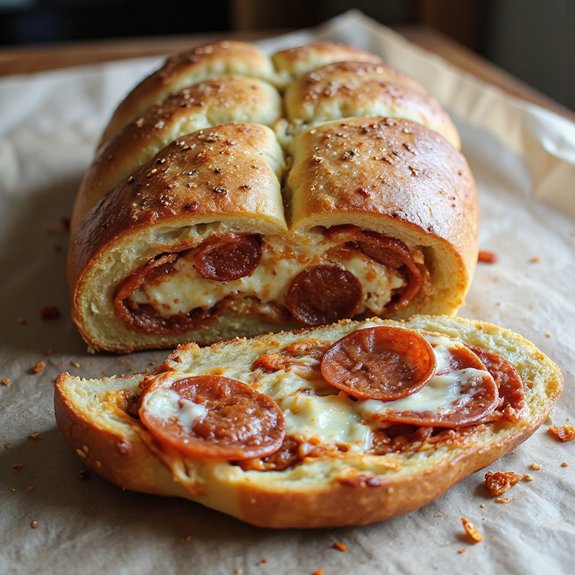
There’s something about tearing into a warm loaf of sourdough pepperoni bread—the crust crackling, cheese bubbling at the edges, ribbons of spicy pepperoni peeking through golden swirls.
This is cozy comfort food in bread form: part snack, part meal, all indulgence.
It’s ideal for busy weeknights or casual gatherings, since it comes together faster than a full pizza night but feels just as special.
I still remember one icy evening when everyone was too tired to cook a “proper” dinner. I stretched leftover sourdough, tucked in pepperoni and mozzarella, and slid the loaf into the oven.
By the time it emerged—scented with toasted flour, smoky meat, and melted cheese—the mood in the house had completely shifted. We sliced, dipped in warm marinara, and called it dinner.
This loaf shines for game days, movie nights, easy entertaining, or quick lunches from leftovers. Ready to bring this dish to life?
Why You’ll Love It
- Delivers bold, pizza-inspired flavor in every cheesy, pepperoni-packed slice
- Makes the most of active sourdough starter for tang and rise
- Doubles as snack, party appetizer, or easy game-day centerpiece
- Can be customized with different meats, cheeses, or seasonings effortlessly
- Bakes up beautifully golden with a soft, tender, swirled crumb
Ingredients
- 120 g sourdough starter, active and bubbly — use at peak for best rise
- 240 g water, room temperature — cooler water slows fermentation slightly
- 350 g bread flour — higher protein for good structure
- 50 g whole wheat flour — adds flavor and a bit more nutrition
- 9 g fine sea salt — enhances gluten and overall flavor
- 15 g olive oil — plus extra for greasing; softens crumb and adds richness
- 120 g pepperoni slices, chopped — choose a flavorful, drier style
- 120 g low-moisture mozzarella cheese, shredded — melts well without excess moisture
- 30 g Parmesan cheese, grated — sharp, salty accent to the filling
- 5 g dried Italian seasoning — adds herbal aroma throughout the loaf
- 2 g garlic powder — distributes garlic flavor more evenly than fresh
- 1 large egg, beaten — for egg wash to give a glossy, browned crust
Step-by-Step Method
Mix the Starter and Water
Whisk the active sourdough starter and room-temperature water in a large mixing bowl. Dissolve the starter mostly so no big clumps remain.
Aim for a milky, uniform mixture. This helps distribute the wild yeast evenly through the dough.
Set the bowl aside briefly while you prepare the flours.
Form the Shaggy Dough
Add the bread flour and whole wheat flour to the starter mixture.
Stir with a wooden spoon until a rough, shaggy dough forms. Scrape the sides of the bowl as you go.
Don’t worry about dryness or smoothness yet. Stop as soon as no dry patches of flour remain.
Autolyse the Dough
Cover the bowl with a towel or plastic wrap.
Let the dough rest at room temperature for 30 minutes. Allow the flour to hydrate and the gluten to begin developing.
Avoid touching or mixing during this time. This rest makes the dough easier to work with later.
Incorporate Salt and Oil
Sprinkle the fine sea salt and olive oil evenly over the dough’s surface.
Use your hands to squeeze, pinch, and fold the dough until the salt and oil are fully absorbed. Work gently but thoroughly.
Continue until the dough feels cohesive and no visible oil streaks remain.
Perform Stretch and Folds
Every 30 minutes, perform a set of stretch-and-folds for 3 to 4 rounds.
Grab one edge of the dough, stretch it up, and fold it over itself. Rotate the bowl and repeat on all sides.
Strengthen the gluten gently. Stop each session when the dough feels smoother and more elastic.
Bulk Ferment the Dough
After the final fold, cover the bowl again.
Let the dough bulk ferment at room temperature until it rises by about 60 to 70 percent. Expect this to take 2 to 3 hours, depending on warmth.
Watch the dough, not the clock. Look for a puffed, slightly domed surface.
Prepare the Work Surface
Lightly flour your counter or work surface.
Gently turn the risen dough out of the bowl, trying not to deflate it aggressively. Dust your hands with a little flour if needed.
Pat the dough softly into a rough rectangle, keeping the thickness fairly even and avoiding tearing.
Roll the Dough Rectangle
Use a rolling pin to roll the dough into a 10×14-inch rectangle.
Keep the thickness uniform from center to edges. Lift and reposition the dough occasionally to prevent sticking.
Add a tiny bit of flour under stubborn spots if needed. Maintain a neat rectangle for easier rolling later.
Add the Fillings Evenly
Sprinkle the chopped pepperoni evenly over the dough, leaving a 1-inch border along one long edge.
Scatter the shredded mozzarella and grated Parmesan evenly on top. Add the dried Italian seasoning and garlic powder.
Distribute everything so each slice will have balanced filling.
Roll and Seal the Loaf
Start rolling from the long edge opposite the clean border.
Roll the dough up tightly into a log, keeping tension without tearing. Reach the clean edge and pinch the seam closed firmly.
Tuck the ends under slightly. Seal everything well to prevent cheese leaking during baking.
Prepare the Pan or Sheet
Line a 9×5-inch loaf pan with parchment paper or place parchment on a baking sheet.
Lightly grease the parchment with a thin film of olive oil. Assure the corners of the pan are lined well.
This prevents sticking and helps the loaf release easily after baking.
Transfer and Proof the Loaf
Place the rolled loaf seam-side down into the prepared pan or onto the lined baking sheet.
Cover loosely with lightly oiled plastic wrap or a clean towel. Let the loaf rise at room temperature until puffy and slightly risen, about 1.5 to 2 hours.
Avoid overproofing.
Preheat the Oven
About 30 minutes before baking, preheat your oven to 425°F (220°C).
Position an oven rack in the middle of the oven. Assure the oven reaches full temperature before the loaf goes in.
This strong initial heat helps the bread spring up and set its structure quickly.
Egg Wash and Score the Top
Beat the egg in a small bowl. Brush the top of the loaf gently with the egg wash using a pastry brush.
Use a sharp knife or lame to score 3 to 4 diagonal slashes across the top. Cut swiftly and confidently.
These cuts guide expansion and create an attractive crust.
Bake at High Then Lower Heat
Place the loaf in the hot oven and bake for 15 minutes at 425°F (220°C).
Then reduce the temperature to 375°F (190°C) without opening the door. Continue baking for 18 to 20 minutes.
Check that the loaf is deeply golden and the internal temperature reaches about 200°F (93°C).
Cool Completely Before Slicing
Remove the bread from the oven and lift it carefully from the pan using the parchment.
Transfer it to a wire rack. Let it cool for at least 45 minutes.
Allow the crumb to set and the cheese to firm slightly. Slice only when mostly cool to avoid a gummy interior.
Ingredient Swaps
- Use all-purpose flour in place of bread flour; reduce water by 10–20 g if the dough feels very sticky.
- Substitute turkey or chicken pepperoni for a leaner option, or finely diced salami/chorizo if pepperoni isn’t available.
- For a vegetarian version, replace pepperoni with sautéed mushrooms, olives, or sun-dried tomatoes (blot well to avoid excess moisture).
- Swap mozzarella with any good melting cheese (provolone, Monterey Jack, mild cheddar) and Parmesan with Grana Padano or Pecorino.
- For lower lactose, use lactose-free cheese or a hard aged cheese in place of mozzarella, and skip the Parmesan or use a lactose-free alternative.
You Must Know
– Scale • When doubling the recipe for two loaves: Multiply all ingredients by 2 but keep fermentation times similar, watching for the same 60–70% rise in bulk and “puffy yet still springy” feel before baking.
Larger batches don’t necessarily need longer rises; dough cues matter more than the clock.
Serving Tips
- Serve warm slices with marinara or pizza sauce for dipping.
- Pair with a simple green salad and red wine for an easy dinner.
- Cut into small squares and serve as a game-day appetizer platter.
- Plate with antipasto items: olives, pickled peppers, and fresh mozzarella.
- Toast leftover slices and top with extra cheese for quick “pizza bread.”
Storage & Make-Ahead
Sourdough pepperoni bread keeps in the fridge for up to 4 days, wrapped tightly or in an airtight container.
For make-ahead, bake fully, cool, then slice and freeze up to 2 months.
Reheat slices from frozen at 350°F (175°C) for 8–12 minutes until warmed through and crisp.
Reheating
Reheat slices gently: in a 300°F (150°C) oven for 8–10 minutes.
In a covered skillet over low heat.
Or briefly in the microwave at 50% power to avoid toughness.
Game-Day Snack Boards
Once you’ve warmed a few slices to melty perfection, it’s time to turn this sourdough pepperoni bread into the star of a game-day snack board.
I like to fan the slices across a wooden board, letting the cheese-swirled crumb show, so it looks as inviting as it tastes.
Around the bread, I tuck in small bowls of warm marinara, garlic butter, and a simple olive oil–balsamic dip. Then I add sharp cheddar cubes, briny olives, pepperoncini, and crisp raw veggies for crunch and freshness.
Finish with a pile of grapes or apple slices for sweetness and a little dish of flaky salt and crushed red pepper. Set it out, and let everyone build their own perfect bite.
Final Thoughts
Give this sourdough pepperoni bread a try next time you’re craving something cozy and savory from the oven—you might be surprised how quickly it disappears.
Feel free to tweak the fillings with your favorite meats, cheeses, or seasonings to make it your own.
Frequently Asked Questions
Can I Freeze the Unbaked Loaf and Bake It Straight From Frozen?
Yes, you can, but I wouldn’t. Freeze after shaping and a short proof, then thaw in the fridge overnight before baking. You’ll get a taller rise, crisper crust, and gooier, evenly-melted pockets of cheese.
How Do I Adapt This Recipe for a Bread Machine Cycle?
You can, but I’d only use the machine for mixing and bulk. Add starter, water, flours, salt, oil on “dough” cycle; roll, fill, shape by hand, then proof and bake in your oven.
Is It Possible to Make This Recipe Entirely With Whole Wheat Flour?
Yes, you can, but I’d tweak it: I’d add 10–15% more water, knead longer, and extend rises. Expect a heartier, denser crumb—perfectly cozy, especially warmed with butter beside a steaming bowl of soup.
How Can I Reduce the Sodium Content While Keeping Good Flavor?
You can lower sodium by choosing low-sodium pepperoni, using half the Parmesan, and skipping extra salt. I’d boost flavor with more garlic, herbs, and a drizzle of olive oil, keeping everything warmly savory and satisfying.
What Adjustments Are Needed for Baking at High Altitude?
You’ll lower yeast activity with cooler water, shorten bulk ferment slightly, and add 10–15°F to baking temperature. I’d also increase flour 1–2 tablespoons and water a splash so your loaf still rises dreamily.
Sourdough Pepperoni Bread
Equipment
- 1 large mixing bowl
- 1 medium mixing bowl
- 1 Wooden spoon
- 1 digital kitchen scale
- 1 measuring cup set
- 1 measuring spoon set
- 1 bench scraper
- 1 Rolling Pin
- 1 9×5-inch loaf pan (or baking sheet)
- 1 sheet parchment paper
- 1 sharp knife or lame
- 1 pastry brush
- 1 wire cooling rack
Ingredients
- 120 gram sourdough starter active and bubbly
- 240 gram water room temperature
- 350 gram bread flour
- 50 gram whole wheat flour
- 9 gram fine sea salt
- 15 gram olive oil plus extra for greasing
- 120 gram pepperoni slices chopped
- 120 gram low-moisture mozzarella cheese shredded
- 30 gram Parmesan cheese grated
- 5 gram dried Italian seasoning
- 2 gram garlic powder
- 1 large egg beaten for egg wash
Instructions
- In a large mixing bowl whisk together active sourdough starter and water until mostly dissolved.
- Add bread flour and whole wheat flour to the bowl and mix with a wooden spoon until a rough shaggy dough forms.
- Cover the bowl and let the dough rest for 30 minutes to autolyse.
- Sprinkle salt and olive oil over the dough and squeeze and fold the dough until both are fully incorporated.
- Perform 3 to 4 sets of stretch-and-folds every 30 minutes over 1.5 to 2 hours until the dough becomes smoother and more elastic.
- After the last fold cover the dough and let it bulk ferment at room temperature until increased by about 60 to 70 percent in volume, 2 to 3 hours depending on temperature.
- Lightly flour your work surface, gently turn the dough out, and pat it into a rough rectangle.
- Using a rolling pin roll the dough into a rectangle about 10×14 inches, keeping the thickness even.
- Evenly sprinkle chopped pepperoni, shredded mozzarella, grated Parmesan, Italian seasoning, and garlic powder over the surface, leaving a 1-inch border on one long edge.
- Starting from the opposite long edge, roll the dough up tightly into a log, pinching the seam closed.
- Tuck the ends under slightly to seal and tighten the loaf.
- Line a loaf pan with parchment paper or place a sheet of parchment on a baking sheet and lightly grease it with olive oil.
- Transfer the rolled loaf seam-side down into the prepared loaf pan or onto the parchment-lined baking sheet.
- Cover loosely with lightly oiled plastic wrap or a clean towel and let rise at room temperature until puffy and slightly risen, 1.5 to 2 hours.
- About 30 minutes before baking, preheat the oven to 425°F (220°C) with a rack in the middle position.
- Just before baking, brush the top of the loaf with beaten egg and use a sharp knife or lame to score 3 to 4 diagonal slashes on top.
- Place the loaf in the oven and bake for 15 minutes at 425°F (220°C).
- Reduce the oven temperature to 375°F (190°C) and continue baking for 18 to 20 minutes, or until deeply golden and the internal temperature reaches about 200°F (93°C).
- Remove the bread from the oven, carefully lift it out of the pan using the parchment, and place it on a wire rack.
- Allow the sourdough pepperoni bread to cool at least 45 minutes before slicing to keep the crumb from becoming gummy and to let the cheese set.
Notes

Cynthia Weatherford is a seasoned chef and culinary enthusiast who serves as the Recipe creator of Somonday. With decades of experience in the kitchen and a passion for exploring diverse cuisines, Cynthia brings a blend of creativity and technique to every dish. Known for transforming simple ingredients into show-stopping meals, Cynthia believes that cooking is an art form anyone can master. Dedicated to inspiring home cooks, Cynthia shares approachable recipes, pro tips, and culinary wisdom to make every meal memorable.