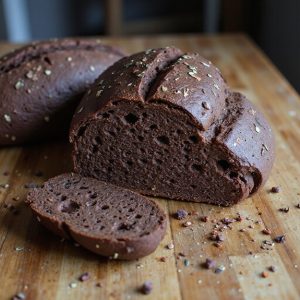
Chocolate Espresso Sourdough Bread
Equipment
- 1 digital kitchen scale
- 2 medium mixing bowls
- 1 large mixing bowl
- 1 Dough scraper
- 1 Wooden spoon or spatula
- 1 bench scraper
- 1 proofing basket (or 1 medium bowl lined with a towel)
- 1 Dutch oven with lid
- 1 sharp knife or bread lame
- 1 Cooling rack
- 1 small saucepan (optional, for melting chocolate)
Ingredients
- 120 gram active sourdough starter 100% hydration
- 350 gram water room temperature
- 30 gram strong brewed espresso cooled
- 450 gram bread flour
- 50 gram whole wheat flour
- 30 gram unsweetened cocoa powder
- 9 gram fine sea salt
- 40 gram granulated sugar
- 60 gram dark chocolate chips or chunks
- 30 gram unsalted butter or neutral oil; softened
- 20 gram honey or maple syrup
- 15 gram milk or cream optional, for softer crumb; room temperature
Instructions
- In a large mixing bowl, whisk together the active sourdough starter, water, and cooled espresso until mostly dissolved.
- Add bread flour, whole wheat flour, and cocoa powder to the bowl and mix with a spoon or hands until no dry flour remains and a shaggy dough forms.
- Cover the bowl and let the dough rest (autolyse) for 30–45 minutes at room temperature.
- Sprinkle salt, sugar, and honey over the dough, then add softened butter and gently squeeze and fold the dough until the additions are fully incorporated.
- Perform the first set of stretch-and-folds by grabbing one side of the dough, stretching it up, and folding it over itself 4–6 times around the bowl.
- Cover and let the dough rest for 30 minutes at room temperature.
- Repeat stretch-and-folds every 30 minutes for 2–3 more rounds, adding chocolate chips during the second round by gently folding them into the dough.
- After the final fold, cover the bowl and allow the dough to bulk ferment at room temperature until roughly doubled and puffy, about 4–6 hours depending on room temperature.
- Lightly flour your work surface, gently turn the dough out, and use a bench scraper to pre-shape it into a loose round.
- Let the dough rest uncovered on the counter for 15–20 minutes to relax.
- Shape the dough into a tight boule or batard by gently stretching and rolling, creating surface tension without tearing.
- Dust the proofing basket or towel-lined bowl with flour, then place the dough seam-side up into the basket.
- Cover and refrigerate for an overnight cold proof of 8–12 hours.
- About 45 minutes before baking, place the Dutch oven with its lid into the oven and preheat to 475°F (245°C).
- Carefully remove the hot Dutch oven, gently invert the dough onto a piece of parchment or directly into the pot, so it is seam-side down.
- Score the top of the dough with a sharp knife or lame to allow controlled expansion.
- Cover the Dutch oven with the lid and bake for 20 minutes at 475°F (245°C).
- Remove the lid, reduce the temperature to 430°F (220°C), and continue baking for 18–22 minutes, until the crust is deeply browned and the loaf sounds hollow when tapped.
- Transfer the bread to a cooling rack and let it cool completely for at least 1–2 hours before slicing.
Notes
For best flavor and structure, ensure your starter is very active before mixing, and err on the side of a slightly longer bulk ferment if your kitchen is cool so the dough feels airy and jiggly before shaping. If the dough seems too sticky, lightly wet your hands instead of adding extra flour, which can dry out the crumb. You can adjust sweetness by increasing or decreasing the sugar or honey and vary intensity by changing the cocoa or espresso amounts slightly, but keep total hydration similar. Dark chocolate chunks hold distinct pockets of melted chocolate, while chips stay more intact; either works, but fold them in gently to avoid tearing the gluten structure. Slicing only when the loaf is fully cool prevents a gummy interior and helps preserve the open, tender crumb that pairs especially well with butter, mascarpone, or a light dusting of powdered sugar.
Tried this recipe?Let us know how it was!