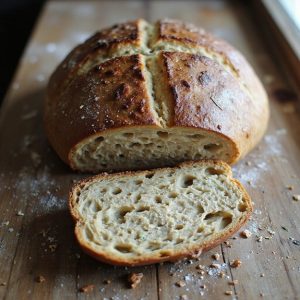
Fresh Milled Sourdough Bread
Equipment
- 1 digital kitchen scale
- 1 grain mill (for milling wheat berries)
- 2 medium mixing bowls
- 1 Dough scraper
- 1 large mixing bowl or dough tub
- 1 proofing basket or 1 medium bowl lined with a clean towel
- 1 lame or sharp serrated knife for scoring
- 1 Dutch oven with lid or baking stone and steam tray
- 1 wire cooling rack
- 1 clean kitchen towel or plastic wrap
Ingredients
- 400 gram wheat berries hard red or hard white
- 100 gram bread flour unbleached optional for strength
- 380 gram water room temperature
- 90 gram active 100% hydration sourdough starter bubbly and recently fed
- 10 gram fine sea salt
Instructions
- Mill the 400 g of wheat berries in your grain mill on a fine setting and combine the fresh flour with the 100 g bread flour in a large mixing bowl.
- Add 320 g of the water to the flour mixture and mix by hand until no dry bits remain, then cover and let autolyse for 45–60 minutes.
- In a small bowl, mix the remaining 60 g water with the 90 g active sourdough starter until mostly dissolved.
- Add the starter mixture to the autolysed dough and pinch and fold until fully incorporated.
- Sprinkle the 10 g salt over the dough and squeeze and fold until the salt is evenly distributed.
- Cover the bowl and begin bulk fermentation at room temperature (21–24°C / 70–75°F) for 3–5 hours, depending on room warmth.
- During the first 2 hours of bulk, perform 3–4 sets of stretch-and-folds every 30–40 minutes, lifting and folding each side of the dough over the center.
- After the last set of folds, let the dough rest undisturbed until it has grown by about 50–75% and looks airy with small bubbles on the surface.
- Lightly flour your work surface, gently turn the dough out, and pre-shape it into a loose round using a bench scraper.
- Let the pre-shaped dough rest uncovered for 15–20 minutes to relax.
- Shape the dough into a tight boule or batard by gently stretching and folding, creating surface tension without tearing.
- Generously flour your proofing basket or towel-lined bowl and place the shaped dough seam-side up inside.
- Cover the basket and proof at room temperature for 45–90 minutes, or until the dough slowly springs back when gently pressed, then refrigerate for 10–14 hours for cold retard.
- About 45 minutes before baking, place your Dutch oven (with lid) in the oven and preheat to 250°C / 480°F.
- When ready to bake, carefully remove the hot Dutch oven, turn the cold dough out onto a piece of parchment seam-side down, and score the top with a lame or sharp knife.
- Lift the dough (with parchment) into the Dutch oven, cover with the lid, and place it back in the oven.
- Bake covered for 20 minutes at 250°C / 480°F, then reduce the temperature to 230°C / 450°F and bake covered for 10 more minutes.
- Remove the lid and continue baking for 10–15 minutes, or until the crust is deep golden-brown and the internal temperature reaches about 96°C / 205°F.
- Carefully remove the loaf from the Dutch oven and cool completely on a wire rack for at least 1–2 hours before slicing.
Notes
Freshly milled flour ferments faster and absorbs water differently, so watch the dough rather than the clock and adjust bulk time and hydration as needed—if the dough feels stiff, add a splash more water; if it feels weak and overly sticky, shorten bulk or add a few more folds. Keep your starter strong by feeding it with some fresh-milled flour for a day or two beforehand, and aim to use it at its bubbly, just-peaked stage. Controlling dough temperature (around 24–26°C / 75–78°F) will make fermentation more predictable; you can use slightly cooler water or a warmer spot in the kitchen to fine‑tune it. For a milder flavor, shorten the cold retard; for more tang and deeper aroma, extend it up to about 18 hours. Store the cooled loaf cut-side down on a board for the first day to preserve the crust, then wrap loosely in a towel or paper bag, and always slice with a sharp serrated knife to avoid compressing the crumb.
Tried this recipe?Let us know how it was!