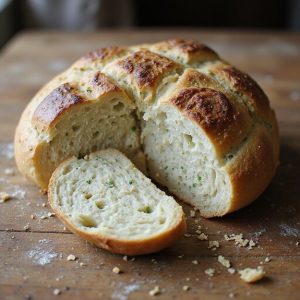
Herb Sourdough Bread
Equipment
- 1 digital kitchen scale
- 2 medium mixing bowls
- 1 large mixing bowl
- 1 Dough scraper
- 1 wooden spoon or silicone spatula
- 1 banneton basket or medium bowl
- 1 clean kitchen towel
- 1 Dutch oven with lid (4–5 qt)
- 1 parchment paper sheet
- 1 sharp knife or bread lame
- 1 Cooling rack
Ingredients
- 100 gram active sourdough starter 100% hydration
- 350 gram water room temperature
- 500 gram bread flour
- 10 gram fine sea salt
- 2 tablespoon extra-virgin olive oil
- 2 tablespoon fresh rosemary finely chopped
- 2 tablespoon fresh thyme leaves finely chopped
- 1 tablespoon fresh parsley finely chopped
- 1 teaspoon garlic powder
- 1 tablespoon olive oil for greasing bowl
- 10 gram rice flour optional; for dusting banneton
Instructions
- In a large mixing bowl, whisk together the active sourdough starter and water until mostly dissolved.
- Add the bread flour to the bowl and mix with a spoon or spatula until no dry flour remains and a shaggy dough forms.
- Cover the bowl and let the dough rest for 30–45 minutes to autolyse.
- Sprinkle the salt, olive oil, rosemary, thyme, parsley, and garlic powder over the dough.
- Pinch and fold the dough repeatedly with your hand until the herbs and salt are evenly incorporated.
- Cover the bowl and let the dough bulk ferment at room temperature for 3–4 hours, performing stretch-and-folds every 30 minutes for the first 2 hours.
- After bulk fermentation, lightly flour your work surface and gently turn the dough out onto it.
- Pre-shape the dough into a loose round by folding the edges toward the center and flipping it seam-side down.
- Let the dough rest uncovered for 20–30 minutes to relax.
- Shape the dough into a tight round or oval loaf by gently stretching the surface and tucking the seams underneath.
- Dust the banneton or a medium bowl lined with a towel with rice flour or regular flour.
- Place the shaped dough seam-side up into the prepared banneton or bowl.
- Cover and refrigerate the dough for 8–12 hours for a cold proof.
- About 45 minutes before baking, place the Dutch oven with its lid into the oven and preheat to 475°F (245°C).
- Remove the dough from the fridge, place a sheet of parchment over the banneton, and invert the loaf onto the parchment.
- Score the top of the dough with a sharp knife or lame to allow controlled expansion.
- Carefully transfer the dough on the parchment into the preheated Dutch oven and cover with the lid.
- Bake covered for 20 minutes at 475°F (245°C).
- Remove the lid, reduce the temperature to 450°F (230°C), and bake for another 18–22 minutes until deep golden brown.
- Lift the bread out of the Dutch oven and cool completely on a cooling rack for at least 1 hour before slicing.
Notes
For best results, ensure your starter is bubbly and recently fed, as sluggish starter will lengthen fermentation times and affect rise. Adjust water slightly depending on flour type and humidity; the dough should feel soft and slightly tacky but not soupy. Fresh herbs give brighter flavor, but you can substitute dried herbs at about one-third the amount if needed. If your kitchen is warm, keep an eye on bulk fermentation so the dough doesn’t overproof; look for roughly doubled size and a slightly domed, airy texture. Letting the bread cool fully prevents a gummy interior and allows the crumb to set, and storing the loaf cut-side down on a board or wrapped in a cloth keeps the crust pleasantly crisp.
Tried this recipe?Let us know how it was!