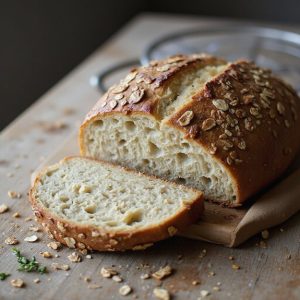
Honey Oat Sourdough Bread
Equipment
- 1 large mixing bowl
- 1 Medium bowl
- 1 digital kitchen scale
- 1 measuring cup set
- 1 set of measuring spoons
- 1 dough scraper or spatula
- 1 banneton or medium bowl lined with a clean towel
- 1 Dutch oven with lid (4–6 quart) or baking stone
- 1 sharp scoring knife or bread lame
- 1 wire cooling rack
Ingredients
- 100 gram active sourdough starter 100% hydration
- 350 gram water room temperature
- 40 gram honey
- 400 gram bread flour
- 50 gram whole wheat flour
- 50 gram rolled oats plus extra for topping
- 9 gram fine sea salt
- 10 gram olive oil or neutral oil for greasing bowl
Instructions
- In a large mixing bowl, whisk together the water and honey until the honey is fully dissolved.
- Stir in the active sourdough starter until loosely combined and slightly milky.
- Add the bread flour, whole wheat flour, and rolled oats to the bowl and mix with a spatula or your hand until no dry flour remains and a rough shaggy dough forms.
- Cover the bowl and let the dough rest (autolyse) for 30 minutes at room temperature.
- Sprinkle the salt over the dough and use your fingers to pinch and fold it in until evenly incorporated.
- Perform a series of 4–6 stretch-and-folds around the dough, pulling up one edge and folding it over toward the center, rotating the bowl as you go.
- Cover and let the dough rest for 30 minutes at room temperature.
- Repeat the stretch-and-fold process 3 more times at 30-minute intervals for a total of about 2 hours of bulk fermentation activity.
- After the final set of folds, lightly oil a clean bowl, place the dough inside, cover, and let it continue to bulk ferment at room temperature until roughly doubled and puffy, 2–4 hours depending on temperature.
- Lightly flour your work surface, gently turn the dough out, and let it relax for 10–15 minutes.
- Shape the dough into a tight round or oval loaf by gently stretching the surface and tucking the edges underneath to build tension.
- Lightly flour your banneton or towel-lined bowl, then roll the top of the shaped loaf on a damp towel and into extra rolled oats to coat the surface.
- Place the dough seam-side up in the prepared banneton or bowl, cover tightly, and refrigerate for 8–12 hours for a cold proof.
- About 45–60 minutes before baking, place the Dutch oven with its lid into your oven and preheat to 475°F (245°C).
- When ready to bake, carefully remove the hot Dutch oven from the oven, gently invert the chilled dough onto a piece of parchment paper so the oat-coated side is up, and quickly score the top with a sharp knife or bread lame.
- Using the parchment as a sling, lower the dough into the hot Dutch oven, cover with the lid, and place it back into the oven.
- Bake covered for 20 minutes at 475°F (245°C).
- Remove the lid, reduce the oven temperature to 450°F (230°C), and continue baking for 18–22 minutes until the loaf is deep golden brown and sounds hollow when tapped on the bottom.
- Carefully transfer the bread from the Dutch oven to a wire cooling rack and let it cool completely for at least 1–2 hours before slicing.
Notes
For best results, ensure your starter is bubbly and recently fed so it can properly lift the dough, and remember that room temperature greatly affects fermentation time, so use the dough’s look and feel (puffy, risen, slightly jiggly) more than the clock. If your dough feels very sticky, lightly dampen your hands rather than adding extra flour, which can make the loaf dense. You can adjust the sweetness by slightly increasing or decreasing the honey, but note that more honey will also speed fermentation. For a stronger oat flavor, toast the rolled oats briefly in a dry pan before adding them, and if you don’t have a Dutch oven, bake on a preheated stone with a tray of hot water on the bottom rack to help create steam and good crust.
Tried this recipe?Let us know how it was!