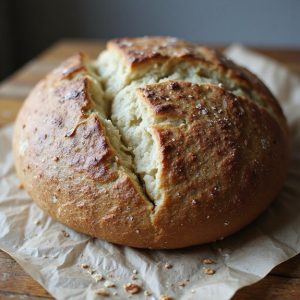
Italian Sourdough Bread
Equipment
- 1 large mixing bowl
- 1 medium mixing bowl
- 1 Kitchen scale
- 1 measuring jug
- 1 Dough scraper
- 1 Wooden spoon
- 1 proofing basket (or 1 bowl lined with floured towel)
- 1 sharp knife or lame
- 1 Dutch oven with lid (or 1 baking stone and 1 oven-safe tray for steam)
- 1 wire cooling rack
- 1 clean kitchen towel
Ingredients
- 100 gram active sourdough starter 100% hydration
- 350 gram water room temperature
- 500 gram bread flour
- 10 gram fine sea salt
- 15 gram olive oil optional
Instructions
- In a medium mixing bowl, mix the active sourdough starter with the water until the starter is mostly dissolved.
- Add the bread flour to the liquid mixture and stir with a wooden spoon until no dry flour remains and a shaggy dough forms.
- Cover the bowl with a clean kitchen towel and let the dough rest (autolyse) for 45 minutes.
- Sprinkle the salt over the dough, add the olive oil if using, and pinch and fold the dough with your hand until the salt and oil are fully incorporated.
- Let the dough rest for 30 minutes, covered, at room temperature.
- Perform a set of stretch-and-folds by grabbing one edge of the dough, stretching it up, and folding it over to the opposite side, repeating 4–6 times around the bowl.
- Cover and rest the dough for 30 minutes, then repeat the stretch-and-fold process.
- Repeat this rest and stretch-and-fold cycle 2 more times for a total of 3–4 sets over about 2 hours of bulk fermentation.
- After the final fold, cover the dough and let it continue to bulk ferment at room temperature until roughly doubled in size, puffy, and showing bubbles along the sides, about 2–4 hours depending on room temperature.
- Lightly flour your work surface and gently turn out the dough from the bowl using a dough scraper.
- Pre-shape the dough into a loose round by folding the edges toward the center and turning it seam side down, then let it rest uncovered for 20 minutes.
- After the bench rest, lightly flour the top of the dough, flip it over, and shape it into a tight round or oval loaf, creating surface tension by pulling it toward you on the counter.
- Generously flour the proofing basket or floured towel-lined bowl, then place the shaped dough seam side up into the basket.
- Cover the basket with a kitchen towel or plastic wrap and place it in the refrigerator to cold-proof for 12–14 hours.
- About 45 minutes before baking, place the Dutch oven with its lid into the oven and preheat to 250°C (480°F).
- When ready to bake, carefully remove the hot Dutch oven from the oven and gently invert the dough from the basket onto a piece of parchment paper, seam side down.
- Score the top of the dough with a sharp knife or lame, making a 1–2 cm deep slash to allow controlled expansion.
- Lift the dough using the parchment paper and place it into the hot Dutch oven, then cover with the lid.
- Bake covered at 250°C (480°F) for 20 minutes to create steam and good oven spring.
- After 20 minutes, reduce the oven temperature to 220°C (430°F), remove the lid, and continue baking for 20–25 minutes until the crust is deep golden brown and the loaf sounds hollow when tapped on the bottom.
- Carefully remove the bread from the Dutch oven and place it on a wire cooling rack.
- Allow the bread to cool completely for at least 1 hour before slicing to let the crumb set and moisture redistribute.
Notes
For best results, ensure your sourdough starter is active and bubbly (fed 4–8 hours before mixing), and adjust fermentation times based on your kitchen temperature: warmer rooms speed up proofing, while cooler rooms slow it down. Use a scale for accurate hydration, and if the dough feels very sticky, lightly wet your hands rather than adding extra flour, which can make the loaf dense. A long cold proof in the refrigerator not only improves flavor but also makes scoring easier, and baking in a preheated Dutch oven traps steam for an open crumb and crisp crust. Store leftover bread cut side down on a board for 1–2 days or slice and freeze it, reheating in the oven or toaster to refresh the texture.
Tried this recipe?Let us know how it was!