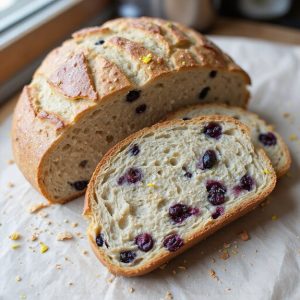
Lemon Blueberry Sourdough Bread
Equipment
- 2 large mixing bowls
- 1 Kitchen scale
- 1 measuring cup set
- 1 measuring spoon set
- 1 wooden spoon or dough whisk
- 1 bench scraper
- 1 9x5-inch loaf pan or 1 standard sourdough Dutch oven
- 1 parchment paper sheet
- 1 clean kitchen towel
- 1 zester or fine grater
- 1 sharp knife or lame
- 1 wire cooling rack
Ingredients
- 120 gram active sourdough starter 100% hydration
- 300 gram water room temperature
- 400 gram bread flour
- 50 gram whole wheat flour
- 8 gram fine sea salt
- 40 gram granulated sugar
- 1 tablespoon lemon zest finely grated
- 2 tablespoon lemon juice freshly squeezed
- 150 gram fresh blueberries rinsed and patted dry
- 10 gram unsalted butter if using loaf pan; softened; for greasing pan
- 10 gram flour for dusting work surface
Instructions
- In a large mixing bowl, whisk together active sourdough starter and water until mostly dissolved.
- Add bread flour, whole wheat flour, sugar, lemon zest, and lemon juice to the bowl and mix until no dry flour remains to form a shaggy dough.
- Cover the bowl with a kitchen towel and let the dough rest (autolyse) for 30 minutes at room temperature.
- Sprinkle salt over the dough and gently pinch and fold it in until evenly incorporated.
- Begin bulk fermentation at room temperature and perform a set of stretch-and-folds every 30 minutes for 2 hours, keeping the bowl covered between sets.
- After the first hour of bulk fermentation, gently sprinkle the dried blueberries over the dough and fold them in carefully to avoid crushing them.
- Continue bulk fermenting the dough until it has risen by about 50%, looks puffed, and shows small bubbles on the surface, usually 4–6 hours total depending on room temperature.
- Lightly flour your work surface, turn the dough out, and gently pre-shape it into a round or log, depending on your baking vessel.
- Let the pre-shaped dough rest uncovered for 15–20 minutes to relax the gluten.
- Shape the dough tightly into a loaf or boule, creating surface tension without tearing the dough.
- If using a loaf pan, grease the pan with softened butter and line the bottom with parchment paper, then place the shaped dough seam-side down into the pan.
- If using a banneton or bowl for Dutch oven baking, lightly flour it, place the dough seam-side up, and cover with a towel.
- Cover the dough and refrigerate it for 8–12 hours for a cold final proof to develop flavor and structure.
- When ready to bake, preheat the oven to 450°F (230°C), placing the Dutch oven inside if using one.
- If baking in a loaf pan, place the pan on the middle rack; if baking in a Dutch oven, carefully transfer the dough onto parchment seam-side down, score the top, and place it into the hot Dutch oven.
- Bake for 20 minutes covered (or with steam if using a loaf pan) to encourage oven spring.
- Reduce the oven temperature to 425°F (220°C), remove the lid or steam source, and bake for an additional 20–25 minutes until the crust is deep golden and the internal temperature reaches about 205°F (96°C).
- Remove the bread from the oven, carefully take it out of the pan or Dutch oven, and place it on a wire rack to cool completely for at least 1–2 hours before slicing.
Notes
For best results, make sure your sourdough starter is bubbly and recently fed, as a weak starter will give dense bread and poor rise. Dry your blueberries very well so they do not add excess moisture that can create gummy pockets, and fold them in gently to avoid smashing them and streaking the dough. Adjust bulk fermentation time based on your kitchen temperature—warmer rooms ferment faster—and always go by dough appearance more than the clock. A tight final shape with good surface tension helps create an open but controlled crumb, while full cooling before slicing prevents the interior from becoming gummy and preserves the bread’s structure and lemon aroma.
Tried this recipe?Let us know how it was!