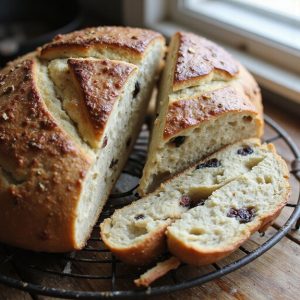
Olive Sourdough Bread
Equipment
- 1 digital kitchen scale
- 2 medium mixing bowls
- 1 large mixing bowl
- 1 Dough scraper
- 1 Wooden spoon or spatula
- 1 bench scraper
- 1 proofing basket (or medium bowl lined with a floured towel)
- 1 Dutch oven with lid (or heavy lidded oven-safe pot)
- 1 sharp lame or serrated knife
- 1 wire cooling rack
Ingredients
- 400 gram bread flour
- 100 gram whole wheat flour
- 100 gram active 100% hydration sourdough starter
- 350 gram water room temperature
- 10 gram fine sea salt
- 120 gram pitted olives roughly chopped
- 15 gram extra-virgin olive oil
- 10 gram coarse cornmeal or semolina for dusting
- 20 gram rice flour optional; for dusting proofing basket
Instructions
- In a large mixing bowl, whisk together the bread flour and whole wheat flour until evenly combined.
- Add the sourdough starter and water to the flour and mix with your hand or a spatula until no dry bits remain and a rough, shaggy dough forms.
- Cover the bowl and let the dough rest (autolyse) for 45–60 minutes at room temperature.
- Sprinkle the salt over the dough and mix by pinching and folding until the salt is fully incorporated and the dough feels smoother.
- Add the chopped olives and olive oil to the dough and gently fold until the olives are evenly distributed.
- Begin bulk fermentation by covering the bowl and letting the dough rest at room temperature for 3–4 hours, depending on warmth.
- During the first 90 minutes of bulk fermentation, perform 3–4 sets of stretch-and-folds every 30 minutes, pulling each side of the dough up and folding it over itself.
- After the final stretch-and-fold, let the dough rest undisturbed for the remainder of bulk fermentation until it has risen by about 50% and shows bubbles along the sides.
- Lightly flour your work surface and gently turn the dough out of the bowl.
- Using a bench scraper, pre-shape the dough into a loose round by folding the edges toward the center and flipping it seam side down.
- Let the pre-shaped dough rest on the counter, covered with a towel, for 20–30 minutes to relax.
- Lightly flour the top of the dough, flip it over, and shape it into a tight boule or batard by folding and rolling to create surface tension.
- Generously dust your proofing basket with a mixture of rice flour and wheat flour, or line a bowl with a well-floured towel.
- Place the shaped dough seam side up in the prepared basket or bowl.
- Cover the dough and let it proof at room temperature for 1–2 hours, or until slightly puffy, then refrigerate for 8–12 hours for cold retard (optional but recommended).
- About 45 minutes before baking, place the Dutch oven with its lid into the oven and preheat to 250°C (480°F).
- Cut a piece of parchment paper and place it over the proofed dough, then invert the basket to release the loaf onto the parchment, now seam side down.
- Score the top of the dough with a lame or sharp knife to allow for controlled expansion.
- Carefully remove the hot Dutch oven from the oven, lift the dough using the parchment, and place it inside the pot.
- Cover with the lid and bake for 20 minutes at 250°C (480°F).
- After 20 minutes, reduce the oven temperature to 230°C (450°F), remove the lid, and continue baking for 20–25 minutes until the crust is a deep golden brown.
- Remove the loaf from the Dutch oven and place it on a wire rack to cool completely for at least 1–2 hours before slicing.
Notes
For best results, use an active, bubbly starter that has peaked within a few hours of feeding, as sluggish starter will lengthen fermentation and can lead to a dense loaf. If your kitchen is warm, shorten bulk fermentation slightly and rely more on the dough’s look and feel than strict timing: it should be airy, jiggly, and about 50% risen. Olives add moisture and weight, so avoid overloading the dough; if you add more olives, gently fold them in during the last set of stretch-and-folds to avoid tearing gluten. A well-preheated Dutch oven is key to good oven spring and blistered crust; resist slicing while warm so the crumb can set and stay moist.
Tried this recipe?Let us know how it was!