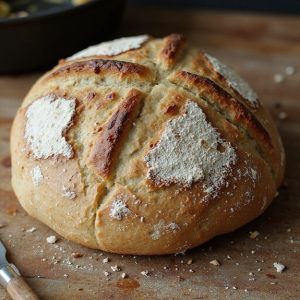
Same Day Sourdough Bread
Equipment
- 2 Mixing bowls
- 1 digital kitchen scale
- 1 measuring jug
- 1 Dough scraper
- 1 bench scraper
- 1 clean kitchen towel
- 1 banneton or 1 medium bowl
- 1 Dutch oven with lid
- 1 sharp razor or lame
- 1 wire cooling rack
Ingredients
- 100 gram active sourdough starter 100% hydration
- 350 gram warm water about 30°C
- 450 gram bread flour
- 50 gram whole wheat flour
- 10 gram fine sea salt
- 10 gram olive oil optional; for softer crust
- 10 gram rice flour for dusting banneton
Instructions
- In a mixing bowl whisk together the warm water and active sourdough starter until mostly dissolved.
- Add the bread flour and whole wheat flour to the bowl and mix with your hand or a dough scraper until no dry flour remains and a shaggy dough forms.
- Cover the bowl with a towel and let the dough rest (autolyse) for 30 minutes at warm room temperature.
- Sprinkle the salt over the dough, add the olive oil if using, and squeeze and fold the dough until the salt and oil are fully incorporated.
- Perform 1 minute of stretch-and-folds in the bowl by pulling one side of the dough up and folding it over, rotating the bowl and repeating.
- Cover the dough and let it rest 30 minutes at warm room temperature (around 24–27°C).
- Repeat the stretch-and-fold process three more times every 30 minutes for a total of 4 rounds over 2 hours.
- After the final set of folds, cover the bowl and let the dough rise at warm room temperature for 1 to 1.5 hours, or until roughly doubled and puffy.
- Lightly flour your work surface and gently turn the dough out onto it, trying not to deflate it too much.
- Use a bench scraper to pre-shape the dough into a loose round by tucking the edges underneath and creating surface tension.
- Let the dough rest uncovered on the counter for 15–20 minutes to relax.
- For the final shape, gently flip the dough over, stretch the bottom edge up and over to the center, then fold the sides in and roll it up to form a tight boule or batard.
- Dust the banneton or bowl generously with a mix of rice flour and a little wheat flour to prevent sticking.
- Place the shaped dough seam side up into the prepared banneton or bowl.
- Cover and let the dough proof at warm room temperature for 45–75 minutes, or until it looks noticeably risen and springs back slowly when gently pressed.
- About 30 minutes before baking, place the Dutch oven with its lid into the oven and preheat to 250°C (480°F).
- When ready to bake, carefully remove the hot Dutch oven from the oven and take off the lid.
- Gently invert the dough onto a piece of parchment paper so it is seam side down.
- Use a razor or lame to score the top of the dough with one long slash about 1 cm deep, or a pattern of your choice.
- Lift the dough using the parchment and place it into the hot Dutch oven, then cover with the lid.
- Return the Dutch oven to the oven and bake covered at 250°C (480°F) for 20 minutes to create steam and oven spring.
- After 20 minutes remove the lid, reduce the temperature to 230°C (450°F), and bake for another 18–22 minutes until deep golden brown.
- Carefully remove the loaf from the Dutch oven and place it on a wire rack.
- Let the sourdough cool completely for at least 1 hour before slicing to allow the crumb to set.
Notes
For best same-day sourdough, keep your starter very active by feeding it 4–8 hours before mixing the dough and ensuring it has doubled and is bubbly when used. A warm environment is key to speeding fermentation, so if your kitchen is cool, use a proofing box, warm oven with the light on, or a sunny spot to maintain 24–27°C. If the dough feels sluggish, extend the bulk rise or proof rather than rushing to bake; watching the dough (its volume, bubbles, and feel) is more reliable than strictly following the clock. Adjust the water slightly if your flour is very thirsty or your dough feels too sticky to handle, and dust your banneton generously to avoid sticking, especially with a wetter dough. Finally, resist cutting into the bread while hot, because slicing too early can make the crumb gummy and collapse the structure.
Tried this recipe?Let us know how it was!