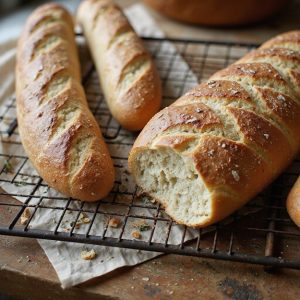
Sourdough Baguette
Equipment
- 1 Kitchen scale
- 2 large mixing bowls
- 1 Dough scraper
- 1 plastic dough scraper or flexible spatula
- 1 clean kitchen towel
- 1 baking sheet or baguette pan
- 1 small oven-safe pan for steam
- 1 lame or sharp serrated knife
- 1 Cooling rack
- 1 spray bottle (optional)
Ingredients
- 150 gram active sourdough starter 100% hydration
- 375 gram water room temperature
- 500 gram bread flour
- 10 gram fine sea salt
- 10 gram water for dissolving salt
- 1 Extra bread flour for dusting
Instructions
- In a large mixing bowl, whisk together 150 g active sourdough starter with 375 g room-temperature water until mostly dissolved.
- Add 500 g bread flour to the bowl and mix with your hand or a dough scraper until no dry flour remains and a shaggy dough forms.
- Cover the bowl with a towel and let the dough rest (autolyse) for 45–60 minutes at room temperature.
- In a small bowl, dissolve 10 g fine sea salt in 10 g water, then pour it over the dough.
- Pinch and fold the dough with damp fingers until the salt mixture is fully incorporated and the dough feels smoother.
- Cover the bowl and let the dough bulk ferment at room temperature for 3–4 hours, performing 3–4 sets of stretch-and-folds every 30–45 minutes during the first 2 hours.
- To stretch and fold, dampen your hand, grab one side of the dough, stretch it up gently, and fold it over the center, rotating the bowl and repeating 4–6 times per set.
- After the final set of folds, cover the dough and let it rest undisturbed until it has risen about 50% and shows bubbles along the sides.
- Transfer the dough to a lightly floured work surface and gently pat it into a rectangle, trying not to deflate it completely.
- Divide the dough into 3 equal pieces (about 340 g each) using a dough scraper.
- Lightly preshape each piece into a loose log by folding the edges to the center and rolling gently.
- Cover the logs with a towel and let them rest for 20–30 minutes to relax the gluten.
- To shape a baguette, lightly flour the surface, gently flatten one log into a rough rectangle, and fold the top third down to the center, sealing with your fingers.
- Fold the bottom third up over the center, seal again, then fold the dough lengthwise in half and pinch the seam firmly closed.
- Roll the cylinder gently from the center outward with your hands to elongate it to about 12–14 inches, tapering the ends slightly.
- Place each shaped baguette seam-side down on a lightly floured towel or baguette pan, making folds in the towel between loaves for support if using a towel.
- Cover loosely and let the baguettes proof at room temperature for 45–75 minutes, or until slightly puffy and slowly springing back when gently pressed.
- About 30 minutes before baking, place a baking sheet or stone on the middle rack and a small oven-safe pan on the lower rack, then preheat the oven to 475°F (245°C).
- When ready to bake, gently transfer the baguettes onto the preheated baking sheet or stone, keeping their shape as much as possible.
- Score each baguette with 3–5 overlapping diagonal slashes along the length using a lame or sharp serrated knife at a shallow angle.
- Pour a cup of hot water into the preheated pan in the bottom of the oven to create steam, and quickly close the door.
- Bake the baguettes at 475°F (245°C) for 10 minutes with steam, optionally misting the oven walls with a spray bottle right after loading.
- After 10 minutes, carefully remove the steam pan, reduce the temperature to 450°F (230°C), and continue baking for another 12–15 minutes until deep golden brown with a crisp crust.
- Transfer baked baguettes to a cooling rack and let them cool for at least 45 minutes before slicing to allow the crumb to set.
Notes
For best results, use a lively, recently fed starter, as sluggish starter will extend fermentation times and can lead to dense loaves; adjust bulk fermentation based on dough appearance rather than the clock, looking for a 40–60% rise and visible gas bubbles. Warmer kitchens speed fermentation, so in hot weather shorten bulk and proof times or use cooler water. Proper shaping and tight surface tension are crucial for an open crumb and nice ears, so handle the dough gently to avoid degassing too much while still sealing seams firmly. Steam in the first part of baking keeps the crust flexible so the loaves can fully expand, and a thoroughly preheated baking surface helps achieve a good oven spring. Finally, resist cutting while warm, because slicing too early compresses the crumb and makes it gummy; completely cooled baguettes keep their crisp crust and airy interior much better.
Tried this recipe?Let us know how it was!