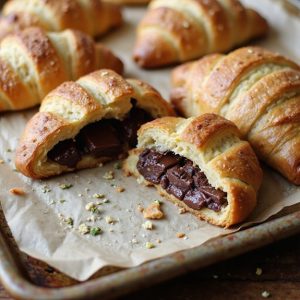
Sourdough Chocolate Croissants
Equipment
- 1 digital kitchen scale
- 2 large mixing bowls
- 1 Small bowl
- 1 Dough scraper
- 1 Rolling Pin
- 1 ruler or measuring tape
- 2 rimmed baking sheets
- 2 sheets parchment paper
- 1 pastry brush
- 1 plastic wrap roll or reusable cover
- 1 Sharp knife or pizza cutter
- 1 pastry board or clean work surface
Ingredients
- 120 gram active sourdough starter 100% hydration
- 250 gram whole milk warm
- 60 gram granulated sugar
- 1 large egg room temperature
- 400 gram bread flour
- 50 gram all-purpose flour
- 8 gram fine sea salt
- 30 gram unsalted butter softened
- 250 gram unsalted butter cold for laminating
- 180 gram dark chocolate batons or chopped dark chocolate
- 1 large egg for egg wash
- 15 gram whole milk for egg wash
Instructions
- In a large bowl whisk together the active sourdough starter, warm milk, sugar, and egg until smooth.
- Add bread flour, all-purpose flour, and salt to the bowl and mix with a dough scraper until a rough shaggy dough forms.
- Knead the dough briefly by hand until it comes together, then add the softened butter and continue kneading 3–4 minutes until smooth but still slightly tacky.
- Shape the dough into a rectangle, cover the bowl tightly, and let rest at room temperature for 30–45 minutes.
- Transfer the covered dough to the refrigerator and chill for at least 6 hours or overnight until firm.
- Place the cold laminating butter between two sheets of parchment and pound and roll it into a 15 x 15 cm square, then chill until just firm but pliable.
- On a lightly floured surface roll the cold dough into a 25 x 25 cm square, place the butter square in the center at a 45° angle, and fold the dough corners over to fully encase the butter.
- Roll the butter-encased dough into a long rectangle about 20 x 60 cm, keeping edges straight and thickness even.
- Fold the rectangle into thirds like a letter, wrap in plastic, and chill for 30–45 minutes.
- Rotate the dough 90°, roll again to 20 x 60 cm, fold into thirds, wrap, and chill for another 30–45 minutes.
- Repeat the rolling and folding one more time for a total of three folds, then wrap well and chill for at least 2 hours or overnight.
- When ready to shape, roll the laminated dough into a rectangle about 25 x 40 cm, trimming edges to neaten if necessary.
- Using a ruler and sharp knife or pizza cutter, cut the dough into long triangles with a base of about 8–9 cm and full height of the rectangle.
- Place 2–3 chocolate batons or a tablespoon of chopped chocolate along the base of each triangle, pressing lightly so they adhere.
- Starting at the base, roll each triangle snugly toward the tip without squashing the layers, slightly stretching the tip as you roll.
- Arrange the rolled croissants on parchment-lined baking sheets with the pointed tips tucked underneath and spaced well apart.
- Cover the trays loosely with plastic wrap or a large bag and proof at a warm room temperature until puffy, jiggly, and nearly doubled, about 4–6 hours depending on starter strength and room temperature.
- Near the end of proofing, whisk together the egg and milk for the egg wash until smooth.
- Preheat the oven to 200°C (390°F) with racks in the upper and lower thirds.
- Gently brush the croissants with a thin, even layer of egg wash, avoiding the cut edges to preserve lamination.
- Bake the croissants for 10 minutes at 200°C (390°F), then reduce heat to 180°C (355°F) and bake another 8–10 minutes until deep golden brown.
- Rotate the trays halfway through baking for even browning if needed.
- Transfer baked croissants to a wire rack and let cool at least 20 minutes before serving so the crumb sets and chocolate thickens slightly.
Notes
For best lamination, keep everything as cold as possible: if the butter starts to feel soft or the dough stretches instead of rolls, chill it again before continuing. Strong, active starter is crucial; if your dough seems sluggish, extend the initial cold fermentation overnight to develop flavor and strength. Use high-quality, high-fat European-style butter and good dark chocolate for the most pronounced flavor and flakiness. Control proofing carefully: under-proofed croissants will burst and leak butter, while over-proofed ones will deflate and bake up flat. Finally, bake until fully deep golden even if it feels a bit longer than expected, as adequate color is key to crisp layers and rich flavor in sourdough croissants.
Tried this recipe?Let us know how it was!