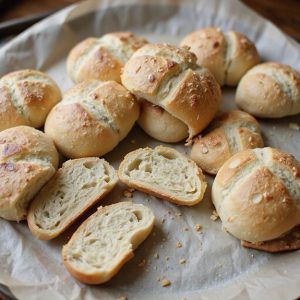
Sourdough Ciabatta Rolls
Equipment
- 1 large mixing bowl
- 1 medium mixing bowl
- 1 digital kitchen scale
- 1 Dough scraper
- 1 wooden spoon or silicone spatula
- 2 rimmed baking sheets
- 2 sheets parchment paper
- 1 clean kitchen towel
- 1 plastic wrap or reusable cover
- 1 Oven
Ingredients
- 150 gram active sourdough starter 100% hydration
- 375 gram water room temperature
- 450 gram bread flour unbleached
- 50 gram whole wheat flour finely milled
- 10 gram fine sea salt
- 15 gram olive oil plus extra for greasing
- 20 gram water for dissolving salt
- 1 Extra bread flour for dusting work surface
Instructions
- In a large mixing bowl, whisk together the active sourdough starter and 375 g room-temperature water until mostly dissolved.
- Add the bread flour and whole wheat flour to the bowl and mix with a spoon or spatula until no dry flour remains and a shaggy dough forms.
- Cover the bowl with plastic wrap or a reusable cover and let the dough rest (autolyse) for 45–60 minutes at room temperature.
- In a small bowl, dissolve the fine sea salt in 20 g water and stir in the olive oil.
- Pour the salt and oil mixture over the dough and squeeze and fold with your hand until it is fully incorporated and the dough feels more cohesive.
- Cover the bowl and let the dough bulk ferment at room temperature for 3–4 hours, performing stretch-and-folds every 30 minutes for the first 2 hours.
- To stretch and fold, lightly wet your hand, grab one side of the dough, stretch it up, and fold it over the center, repeating on all four sides.
- After the final fold, cover the dough and let it rest undisturbed until roughly doubled, bubbly on top, and domed at the edges.
- Lightly oil a medium mixing bowl, gently transfer the dough into it, cover, and refrigerate for 8–12 hours or overnight for better flavor and structure.
- When ready to shape, generously flour your work surface and carefully tip the cold dough out without deflating it.
- Dust the top of the dough with flour and gently stretch it into a loose rectangle about 2–3 cm thick, avoiding pressing out the air.
- Using a floured dough scraper, divide the rectangle into 8 even pieces, cutting straight down to preserve the internal bubbles.
- Slide your hands or the scraper under each portion and gently transfer the pieces to two parchment-lined baking sheets, spacing them well apart.
- If desired, lightly tug each piece into a more uniform rectangle, handling as little as possible to keep them airy.
- Cover the rolls loosely with a floured kitchen towel and let them proof at room temperature for 45–75 minutes, until slightly puffy and jiggly.
- About 30 minutes before baking, preheat the oven to 230°C (450°F) and place an empty tray on the bottom rack for steam if desired.
- Just before baking, lightly mist or sprinkle the rolls with water to encourage a thin, crisp crust.
- Place the baking sheets in the oven, carefully pour a small cup of hot water into the empty tray for steam, and close the door quickly.
- Bake the rolls for 18–22 minutes, rotating the pans halfway through, until golden brown with a crisp crust and a hollow sound when tapped on the bottom.
- Transfer the baked rolls to a wire rack and let them cool for at least 30 minutes before slicing to allow the crumb to set.
Notes
For best results, ensure your starter is at peak activity (domed and bubbly) before mixing, as sluggish starter will lengthen fermentation time and reduce oven spring; adjust bulk fermentation by watching the dough rather than the clock, looking for visible bubbles and a soft, airy feel. A wetter dough is key to an open ciabatta crumb, so resist the urge to add extra flour, and instead use wet or oiled hands and tools to manage stickiness. Cold fermentation in the fridge develops flavor and makes the dough easier to handle, while gentle cutting and minimal shaping preserve the internal gas pockets that create the characteristic holes. If your kitchen is cool, extend proofing times, and if it is very warm, check the dough earlier to avoid over-proofing, which leads to flat rolls. Finally, strong initial heat and steam help maximize oven spring and a thin, crisp crust, so preheat thoroughly and keep the oven door closed as much as possible during baking.
Tried this recipe?Let us know how it was!