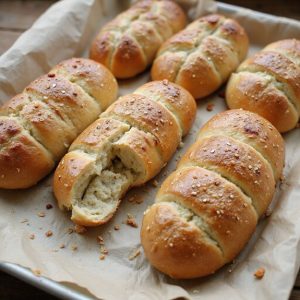
Sourdough Hoagie Rolls
Equipment
- 1 large mixing bowl
- 1 Small mixing bowl
- 1 Kitchen scale
- 1 measuring cup
- 4 Measuring spoons
- 1 Dough scraper
- 1 clean kitchen towel
- 1 plastic wrap or dough cover
- 1 Baking sheet
- 1 sheet parchment paper
- 1 sharp knife or lame
- 1 wire cooling rack
- 1 pastry brush (optional, for egg wash or water)
Ingredients
- 200 gram active sourdough starter 100% hydration
- 360 gram water room temperature
- 30 gram olive oil
- 500 gram bread flour
- 50 gram whole wheat flour
- 12 gram fine sea salt
- 20 gram granulated sugar
- 1 large egg beaten for egg wash optional
- 15 milliliter water for egg wash optional
- 15 gram sesame seeds optional topping optional
Instructions
- Combine active sourdough starter, water, and olive oil in a large mixing bowl and whisk until the starter is mostly dissolved.
- Add bread flour, whole wheat flour, sugar, and salt to the bowl and mix with a dough scraper or your hands until a rough shaggy dough forms.
- Cover the bowl with plastic wrap or a towel and let the dough rest for 30 minutes to autolyse.
- After resting, knead the dough on a lightly floured surface for 8–10 minutes until smooth, elastic, and slightly tacky.
- Place the dough back into a lightly oiled bowl, cover, and let it bulk ferment at room temperature for 3–3.5 hours, performing 2–3 sets of stretch and folds during the first 90 minutes.
- When the dough has risen by about 60–70% and feels airy and puffy, gently turn it out onto a lightly floured surface.
- Divide the dough into 6 equal pieces, using a kitchen scale for accuracy if desired.
- Preshape each piece into a loose round, cover with a towel, and let rest for 15 minutes.
- Shape each round into a hoagie roll by gently flattening into a rectangle, then tightly rolling into a log about 6–8 inches long, sealing the seam well.
- Place the shaped rolls seam-side down on a parchment-lined baking sheet, spacing them a few inches apart.
- Lightly cover the rolls with plastic wrap or a towel and let them proof at room temperature for 45–75 minutes, or until puffy and nearly doubled.
- About 20 minutes before baking, preheat the oven to 425°F (220°C) and place an empty metal pan on the lower rack for steam if desired.
- If using egg wash, whisk the egg and 15 ml water in a small bowl, then gently brush the tops of the proofed rolls.
- Sprinkle sesame seeds over the egg-washed rolls if using.
- Score each roll with a sharp knife or lame down the center at a shallow angle.
- Just before baking, pour a cup of hot water into the empty pan in the oven to create steam, then quickly close the door.
- Place the baking sheet with the rolls on the middle rack and bake for 15–20 minutes, or until deep golden brown and hollow-sounding when tapped on the bottom.
- Transfer the baked rolls to a wire cooling rack and let cool completely or at least 30 minutes before slicing.
Notes
For best results, use a vigorous starter that has recently peaked, as weak starter will lengthen fermentation and make the crumb denser; adjust proofing times based on your room temperature and look for visual cues like puffiness rather than watching the clock strictly. Higher hydration gives a more open, softer crumb, but if the dough feels too sticky you can lightly oil your hands instead of adding extra flour to preserve tenderness. For a chewier crust, bake without egg wash and keep the steam; for a softer sandwich-style crust, use egg wash and skip the steam pan. These rolls freeze well once completely cooled, so you can slice, wrap tightly, and freeze them, then refresh in a warm oven before serving for nearly fresh-baked texture.
Tried this recipe?Let us know how it was!