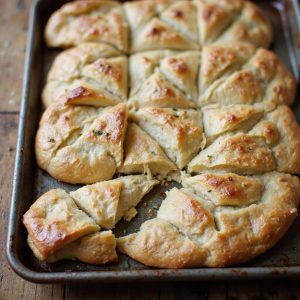
Sourdough Puff Pastry
Equipment
- 1 digital kitchen scale
- 2 medium mixing bowls
- 1 large mixing bowl
- 1 Dough scraper
- 1 Rolling Pin
- 1 pastry brush
- 1 sharp knife or pastry wheel
- 1 ruler (optional, for measuring dough)
- 2 baking sheets
- 2 sheets parchment paper
- 1 plastic wrap roll
Ingredients
- 200 gram sourdough starter 100% hydration active and bubbly
- 120 gram water room temperature
- 250 gram unsalted butter cold cut into chunks
- 300 gram all-purpose flour plus extra for dusting
- 8 gram fine sea salt
- 10 gram granulated sugar optional for slightly sweet pastry
- 5 gram lemon juice or white vinegar optional for tenderness
Instructions
- In a large mixing bowl whisk together the all-purpose flour, fine sea salt, and granulated sugar if using.
- In a medium mixing bowl stir the sourdough starter, water, and lemon juice or vinegar until well combined.
- Pour the wet mixture into the dry ingredients and mix with a dough scraper until a rough shaggy dough forms.
- Knead the dough gently by hand for 1–2 minutes just until it comes together without dry patches, then shape into a rough rectangle.
- Wrap the dough tightly in plastic wrap and refrigerate for 30–45 minutes to relax the gluten.
- Place the cold unsalted butter chunks between two sheets of parchment paper and pound with a rolling pin into a flat rectangle about 15 x 15 cm and 1–1.5 cm thick.
- Chill the butter block in the refrigerator for 15 minutes until firm but still pliable.
- Lightly flour your work surface and roll the rested dough into a rectangle about 30 x 20 cm.
- Place the butter block in the center of the dough so the corners of the butter point toward the middle of each dough side (like a diamond).
- Fold the four corners of the dough over the butter to completely encase it, pinching seams to seal well.
- Gently roll the butter-encased dough into a long rectangle about 45 x 20 cm, keeping thickness even and edges as straight as possible.
- Perform a simple letter fold by folding the top third of the dough down toward the center and the bottom third up over it to create three layers.
- Rotate the dough 90 degrees so the folded edge faces you like a book spine, then this counts as your first turn.
- Wrap the dough in plastic wrap and refrigerate for 30–45 minutes to chill and relax.
- Remove the dough and place it with the “spine” on your left, then roll again into a 45 x 20 cm rectangle.
- Repeat the letter fold (top third down, bottom third up), rotate 90 degrees, then wrap and chill for another 30–45 minutes for the second turn.
- Repeat the rolling, folding, rotating, and chilling process one more time for a total of 3 turns.
- After the third turn, wrap the dough tightly and refrigerate for at least 2 hours or up to overnight to fully rest and ferment.
- When ready to bake, preheat the oven to 200°C and line baking sheets with parchment paper.
- On a lightly floured surface roll the rested puff pastry dough to about 3–4 mm thickness, working quickly to keep it cold.
- Use a sharp knife or pastry wheel and ruler to cut desired shapes such as rectangles for turnovers, squares for napoleons, or strips for palmiers.
- Transfer the cut pieces to prepared baking sheets, spacing them apart to allow for puffing.
- If desired, brush the tops lightly with water and sprinkle with a little granulated sugar or leave plain for savory uses.
- Chill the shaped pastry on the baking sheets for 15–20 minutes to firm up before baking.
- Bake at 200°C for 20–25 minutes, or until deeply golden, well puffed, and crisp all the way through.
- Let the pastries cool on the baking sheets for 5 minutes, then transfer to a wire rack to cool completely or serve warm.
Notes
For best results keep everything as cold as possible, working quickly and returning the dough to the fridge whenever it feels soft or sticky so the butter stays in distinct layers and doesn’t melt into the dough. Light, even flouring prevents sticking without making the pastry tough, and brushing off excess flour between folds helps the layers adhere and rise. Active, recently fed starter gives better flavor and lift, but slightly older starter will still work and adds more tang; just avoid very sour or sluggish starter. Always use a sharp knife for cutting so you don’t crush the edges, and resist opening the oven in the first 15 minutes of baking to protect the puff. This dough can be refrigerated up to 2 days or frozen well wrapped for about a month, making it easy to bake small batches as needed.
Tried this recipe?Let us know how it was!