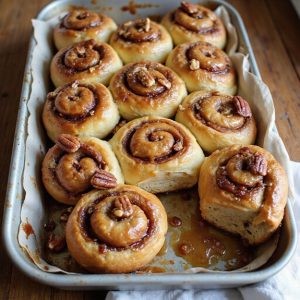
Sourdough Sticky Buns
Equipment
- 1 stand mixer with dough hook (optional but recommended)
- 2 large mixing bowls
- 1 medium mixing bowl
- 1 Small saucepan
- 1 9x13 inch baking pan
- 1 Rolling Pin
- 1 Rubber spatula
- 1 sharp knife or bench scraper
- 1 pastry brush
- 1 Plastic wrap or 1 reusable cover for pan
- 1 Measuring cups and spoons
Ingredients
- 150 gram active sourdough starter 100% hydration
- 250 gram whole milk warm
- 75 gram granulated sugar
- 2 large eggs room temperature
- 100 gram unsalted butter melted and cooled
- 500 gram all-purpose flour
- 8 gram fine sea salt
- 5 gram ground cinnamon
- 1 teaspoon vanilla extract
- 120 gram unsalted butter softened
- 150 gram light brown sugar packed
- 10 gram ground cinnamon
- 2 gram fine sea salt
- 80 gram chopped pecans optional; toasted
- 120 gram unsalted butter
- 160 gram light brown sugar packed
- 120 gram heavy cream
- 60 gram honey or maple syrup
- 3 gram fine sea salt
- 120 gram pecan halves optional
Instructions
- In a large mixing bowl, whisk together active sourdough starter, warm milk, granulated sugar, eggs, melted butter, and vanilla until smooth.
- Add flour, cinnamon, and salt to the wet mixture and stir with a spoon or use a stand mixer on low until a rough dough forms.
- Knead by hand for 8–10 minutes or in the mixer for about 5–7 minutes until the dough is smooth, elastic, and slightly tacky.
- Place the dough in a lightly greased bowl, cover, and let it ferment at room temperature for 3–4 hours until puffy and increased in volume by about 50%.
- Transfer the covered bowl to the refrigerator and cold-proof for at least 6 hours or up to 12 hours to develop flavor and make rolling easier.
- For the sticky topping, combine butter, brown sugar, cream, honey or maple syrup, and salt in a small saucepan over medium heat and cook, stirring, until the sugar is dissolved and the mixture is smooth.
- Pour the warm sticky topping into a greased 9x13-inch pan and tilt the pan to coat the bottom evenly, then sprinkle pecan halves over the sauce if using.
- For the filling, mix softened butter, brown sugar, cinnamon, and salt in a medium bowl to form a spreadable paste, then set aside.
- Turn the chilled dough onto a lightly floured surface and roll it into a rectangle about 12x18 inches, with the long side facing you.
- Spread the cinnamon-sugar filling evenly over the dough, leaving a 1/2-inch border along the top long edge.
- Sprinkle chopped pecans evenly over the filling if using and gently press them into the dough.
- Starting from the long edge closest to you, roll the dough tightly into a log, sealing the seam by pinching it closed.
- Trim the ends if needed, then slice the log into 12 even pieces using a sharp knife or bench scraper.
- Arrange the slices cut side up in the prepared pan on top of the sticky topping, leaving a little space between each bun.
- Cover the pan tightly with plastic wrap or a reusable cover and let the buns proof at warm room temperature for 1.5–3 hours, or until noticeably puffy and almost touching.
- When the buns are nearly ready, preheat the oven to 350°F (175°C) with a rack in the center.
- Bake the sticky buns for 25–30 minutes, or until golden brown on top and an instant-read thermometer in the center reads about 190°F (88°C).
- Let the pan cool on a rack for 5–10 minutes, then carefully invert the buns onto a serving platter so the sticky topping runs over them.
- Spoon any remaining sauce from the pan over the buns, then let them cool slightly before serving warm.
Notes
For best results, make sure your sourdough starter is recently fed and very active so the dough rises within the suggested timeframe, and adjust proofing times based on your kitchen temperature—cool rooms need longer, warm rooms less. If the dough feels too sticky when rolling, chill it briefly and use a light hand with flour to avoid drying it out. The overnight cold proof develops deeper flavor and makes the dough easier to handle, but you can extend the chill up to 24 hours for even tangier buns. When baking, tent loosely with foil if the tops brown too quickly before the centers are done. These buns are best the day they are baked, but you can rewarm leftovers gently in a low oven, and you can also fully assemble and refrigerate the shaped buns overnight, then proof slightly longer in the morning before baking for a convenient make-ahead breakfast.
Tried this recipe?Let us know how it was!