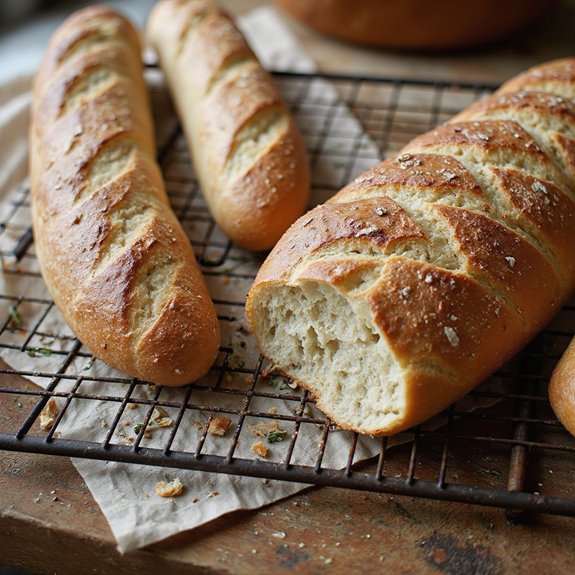
There’s something about pulling a tray of homemade sourdough baguettes from the oven—the crackle of the blistered golden crust, the swirl of steam carrying that tangy, wheaty aroma through your kitchen.
This isn’t a rushed weeknight fix; it’s a slow, deeply satisfying project that rewards a little planning with bakery-level bread.
Think of it as a cozy, hands-on weekend bake, perfect for bread lovers, curious beginners, and anyone who finds calm in simple rituals.
I still remember one rainy Sunday when guests arrived early and dinner wasn’t ready.
Those resting baguettes became the hero: sliced warm, topped with butter, cheese, and olives, they turned waiting into an effortless aperitif.
These loaves shine at family Sunday suppers, casual gatherings, or anytime you want to turn a simple soup or salad into something special.
Ready to bring this sourdough baguette to life?
Why You’ll Love It
- Delivers bold, tangy flavor you can’t get from commercial yeast
- Creates crackly crust with soft, airy, open crumb inside
- Relies on simple pantry ingredients—just flour, water, salt, starter
- Fits into your schedule with mostly hands-off fermentation time
- Impresses guests with bakery-style baguettes straight from your oven
Ingredients
- 150 g active sourdough starter — 100% hydration, recently fed
- 375 g water — room temperature for easier mixing
- 500 g bread flour — high-protein for better chew
- 10 g fine sea salt — dissolves evenly for consistent flavor
- 10 g water — for dissolving the salt before mixing in
- Extra bread flour — for dusting the work surface and towel
Step-by-Step Method
Mix the Starter and Water
Whisk the active sourdough starter with room-temperature water in a large bowl. Dissolve the starter as much as possible so it disperses evenly in the dough.
This helps create consistent fermentation. Aim for a milky, slightly frothy mixture with no large clumps. Scrape the sides of the bowl so all starter is incorporated.
Combine Flour and Form a Shaggy Dough
Add the bread flour to the starter mixture. Mix with your hand or a dough scraper until no dry flour remains.
Form a rough, shaggy mass without worrying about smoothness yet. Make certain all flour is hydrated. Scrape the bowl sides and bottom so no dry bits hide. Cover the bowl once everything is combined.
Rest the Dough for Autolyse
Cover the bowl with a clean kitchen towel. Let the dough rest for 45–60 minutes at room temperature.
Allow the flour to fully hydrate and gluten to begin forming naturally. Avoid touching or stirring during this time. The dough will relax and become easier to stretch. Autolyse improves flavor, texture, and handling.
Dissolve and Add the Salt Mixture
Stir fine sea salt into a small amount of water until it dissolves. Pour this salty liquid evenly over the dough surface.
Use damp fingers to prevent sticking. Distribute the mixture by pinching and folding the dough repeatedly. Continue until the dough feels smoother and more cohesive. Make certain no salty pockets remain.
Stretch and Fold During Bulk Fermentation
Cover the bowl and begin bulk fermentation at room temperature. Every 30–45 minutes for the first 2 hours, perform stretch-and-folds.
Dampen your hand, grab one edge of the dough, gently stretch it upward, then fold it over the center. Rotate the bowl and repeat several times. Build strength without tearing the dough.
Let the Dough Rise Until Light and Bubbly
After the final set of folds, cover the bowl again. Allow the dough to rest undisturbed until it rises about 50% in volume.
Look for small bubbles along the sides and a slightly domed surface. Adjust time based on room temperature. Stop bulk fermentation when the dough feels airy and jiggly, not dense.
Turn Out and Divide the Dough
Lightly flour your work surface. Gently turn the dough out, trying not to deflate it completely.
Pat it into a soft rectangle with your fingertips. Use a dough scraper to divide it into three equal pieces, about 340 grams each. Handle each portion gently to preserve gas. Avoid tearing or aggressively pressing the dough.
Preshape into Loose Logs
Lightly dust each piece with flour if sticky. Fold the edges of one piece toward the center to form a loose log.
Roll it gently to even the shape without tightening too much. Repeat with the remaining pieces. Arrange the logs on the work surface. Cover them with a towel so they don’t dry out.
Rest the Logs to Relax Gluten
Let the preshaped logs rest for 20–30 minutes at room temperature. Keep them loosely covered with a towel.
Allow the gluten to relax so final shaping is easier. Watch that the dough doesn’t spread excessively. This bench rest helps achieve longer, more elegant baguettes with better structure and crumb.
Flatten and Fold into a Rectangle
Lightly flour the surface again if needed. Take one log and gently flatten it into a rough rectangle with your fingertips.
Avoid pressing out all the air. Fold the top third of the dough down toward the center. Seal the edge with your fingers. Create clear, straight folds for a more uniform baguette.
Seal, Fold Lengthwise, and Tighten
Fold the bottom third of the rectangle up over the center and seal again. Then fold the dough lengthwise in half so the long edges meet.
Pinch the seam firmly closed along the entire length. Create gentle surface tension without tearing. This step forms the central cylinder that will become your baguette.
Roll and Elongate the Baguette
Place the cylinder seam-side down. Starting from the center, roll it gently back and forth with your hands.
Gradually move outward to lengthen the dough to about 12–14 inches. Apply slightly more pressure toward the ends to taper them. Keep movement smooth and light. Avoid squeezing hard or degassing the loaf.
Arrange Baguettes for Final Proof
Prepare a lightly floured kitchen towel or baguette pan. Place each shaped baguette seam-side down.
If using a towel, create folds of fabric between loaves to support them. Space them so they don’t touch while rising. Cover loosely with another towel. Keep the surface from drying while the loaves proof.
Proof Until Slightly Puffy
Let the baguettes proof at room temperature for 45–75 minutes. Check readiness by gently pressing the dough with a fingertip.
Look for slow, partial spring-back rather than immediate rebound. The loaves should feel lighter and slightly puffy. Avoid overproofing, which reduces oven spring and can cause flat baguettes.
Preheat Oven and Steam Setup
About 30 minutes before baking, place a baking sheet or stone on the middle rack. Set a small oven-safe pan on a lower rack.
Preheat the oven to 475°F (245°C). Allow enough time for the baking surface to heat thoroughly. Proper preheating assures strong oven spring and nicely caramelized, crisp crust.
Transfer and Score the Baguettes
When ready to bake, gently transfer each baguette onto the preheated baking sheet or stone. Preserve their shape as much as possible.
Use a lame or sharp serrated knife to score 3–5 overlapping diagonal slashes along each loaf at a shallow angle. Cut quickly and confidently to guide expansion in the oven.
Steam and Begin Baking
Carefully pour a cup of hot water into the preheated pan on the lower rack to create steam. Close the oven door quickly to trap moisture.
Bake the baguettes at 475°F (245°C) for 10 minutes with steam. Optionally mist the oven walls just after loading. Steam keeps the crust flexible and promotes oven spring.
Finish Baking to Deep Golden Brown
After 10 minutes, carefully remove the steam pan from the oven. Reduce the temperature to 450°F (230°C).
Continue baking the baguettes for another 12–15 minutes. Watch for a deep golden brown color and a crisp, thin crust. Rotate the pan if needed for even browning. Remove when fully colored and fragrant.
Cool Completely Before Slicing
Transfer the baked baguettes to a cooling rack immediately. Allow them to cool for at least 45 minutes.
Resist cutting too early, as the crumb is still setting and can become gummy. Let steam escape naturally. Once fully cooled, slice and serve. Enjoy the contrast of crisp crust and tender, airy interior.
Ingredient Swaps
- Flour: You can swap up to 50% of the bread flour with all-purpose; for more flavor, replace 10–20% with whole wheat or rye (you may need 5–10 g extra water).
- Gluten-free: Use a strong gluten-free bread flour blend formulated for yeast breads, and expect a denser, less open crumb.
- Salt: Any fine salt (sea, kosher, table) works—if using coarse or kosher, measure by weight (10 g), not volume.
- Starter: A rye or whole-wheat starter can replace the white starter 1:1; the dough may ferment faster and taste more sour.
- Steam setup: If you don’t have a steam pan, bake the baguettes on a preheated baking stone under an inverted roaster lid or Dutch oven for the first 10–12 minutes.
You Must Know
- Doneness • If your baguettes look brown but feel soft: Leave them in an extra 3–5 minutes until the crust is firm and crisp and the bottoms sound hollow when tapped; internally they should be around 205–210°F (96–99°C). This prevents a gummy crumb that often shows up only after cooling.
- Troubleshoot • If the loaves spread sideways and don’t rise tall: Next time, give bulk fermentation less time (aim closer to a 40% rise, not 60%) and tighten surface tension more during shaping so the dough feels slightly springy.
Over-fermented or loosely shaped dough flows outward instead of upward in the oven.
- Flavor Boost • For a tangier, more complex taste: After bulk, refrigerate the shaped baguettes for 8–16 hours covered, then bake straight from cold. Cooler, longer proofing slows yeast but lets acids and flavor compounds build for a more aromatic crust and deeper sour notes.
- Scale • To make 1 or 2 baguettes instead of 3: Divide every ingredient by 3 (for 1 loaf) or by 3 and multiply by 2 (for 2 loaves), keeping starter at 30% of flour (e.g., 50 g starter, 125 g water, 167 g flour, 3.3 g salt per baguette). Keeping these ratios steady preserves dough feel and timing.
- Avoid • If your kitchen is hot (78–82°F / 26–28°C): Use cooler water (around 65–70°F / 18–21°C) and start checking bulk dough at 2–2½ hours instead of 3–4, looking for bubbles and a modest rise. High temps speed fermentation and can push the dough past its peak, giving a sour but dense baguette.
Serving Tips
- Serve warm with high-quality butter, flaky sea salt, and freshly cracked black pepper.
- Pair with soft cheeses, cured meats, olives, and cornichons for a simple French-style apéritif.
- Slice into crostini topped with tomatoes, basil, garlic, and olive oil.
- Use for sandwiches like jambon-beurre, loaded with ham, butter, and crisp lettuce.
- Turn day-old baguette into garlicky croutons for salads or rustic soups.
Storage & Make-Ahead
Sourdough baguettes keep 1–2 days at room temperature in a paper bag, then in plastic if needed.
For make-ahead, refrigerate shaped baguettes up to 12–18 hours before baking.
Baked baguettes freeze well for about 1 month; cool completely, wrap tightly, and re-crisp in a hot oven before serving.
Reheating
Reheat baguette gently to preserve texture.
Use a 300°F (150°C) oven for 8–10 minutes, or briefly steam in a covered skillet.
Avoid microwaving; it softens crust and toughens crumb.
Baguettes in Parisian Café Culture
Often, when I think of Paris, I picture a tiny café table, a chipped white cup of coffee, and a paper-wrapped baguette tucked under someone’s arm as they slip into a chair.
In that scene, bread isn’t a side; it’s the quiet centerpiece of the moment.
When you bake your own sourdough baguettes, you’re inviting that everyday ritual into your kitchen. I picture you tearing off a heel, crumbs scattering, the crust crackling softly as steam escapes.
Maybe you’re dipping it into a bowl of café au lait, or pairing it with salted butter and a few slices of cheese. However you serve it, let it slow you down. Treat each loaf as permission to linger, to snack, to stay awhile.
Final Thoughts
Give this sourdough baguette recipe a try and enjoy the process as much as the crusty, flavorful results.
Once you’ve made it once, have fun tweaking the fermentation time, shaping, or scoring to make the baguettes truly your own.
Frequently Asked Questions
How Can I Adapt This Recipe for a Home Convection Oven?
Use 25°F lower: preheat to 450°F with fan, then 425°F to finish. Shorten bake a few minutes, watch color. Steam still matters—add hot water, quickly close door. Your crust will sing in that swirling heat.
What Common Mistakes Cause Flat or Dense Sourdough Baguettes?
Flat, dense baguettes usually mean weak starter, under‑ or over‑fermentation, rough handling, or poor shaping. I’d watch for a 50% rise, gentle folds, tight shaping, and fierce initial heat with steam to lift them proud.
How Do Altitude Changes Affect Fermentation and Baking Time?
Altitude speeds fermentation and baking, so I watch dough, not clocks. In your thinner, drier air, I’d shorten proofs, lower yeastiness, and bake hotter but slightly shorter, guarding moisture like a warm blanket around your dough.
Can I Convert This to a Fully Whole-Grain Sourdough Baguette?
Yes, you can, but I’d guide you gently: use 60–80% whole grain first, add a bit more water, extend fermentation, and knead/stretch well so your baguettes stay airy, nutty, and beautifully bronzed.
How Do I Scale This Recipe for a Larger Batch?
You’ll scale every ingredient by your chosen factor—double, triple, etc.—keeping ratios identical. I’d mix in multiple bowls, proof in wider containers, and bake in waves so each baguette still gets attentive, hearth‑like care.
Sourdough Baguette
Equipment
- 1 Kitchen scale
- 2 large mixing bowls
- 1 Dough scraper
- 1 plastic dough scraper or flexible spatula
- 1 clean kitchen towel
- 1 baking sheet or baguette pan
- 1 small oven-safe pan for steam
- 1 lame or sharp serrated knife
- 1 Cooling rack
- 1 spray bottle (optional)
Ingredients
- 150 gram active sourdough starter 100% hydration
- 375 gram water room temperature
- 500 gram bread flour
- 10 gram fine sea salt
- 10 gram water for dissolving salt
- 1 Extra bread flour for dusting
Instructions
- In a large mixing bowl, whisk together 150 g active sourdough starter with 375 g room-temperature water until mostly dissolved.
- Add 500 g bread flour to the bowl and mix with your hand or a dough scraper until no dry flour remains and a shaggy dough forms.
- Cover the bowl with a towel and let the dough rest (autolyse) for 45–60 minutes at room temperature.
- In a small bowl, dissolve 10 g fine sea salt in 10 g water, then pour it over the dough.
- Pinch and fold the dough with damp fingers until the salt mixture is fully incorporated and the dough feels smoother.
- Cover the bowl and let the dough bulk ferment at room temperature for 3–4 hours, performing 3–4 sets of stretch-and-folds every 30–45 minutes during the first 2 hours.
- To stretch and fold, dampen your hand, grab one side of the dough, stretch it up gently, and fold it over the center, rotating the bowl and repeating 4–6 times per set.
- After the final set of folds, cover the dough and let it rest undisturbed until it has risen about 50% and shows bubbles along the sides.
- Transfer the dough to a lightly floured work surface and gently pat it into a rectangle, trying not to deflate it completely.
- Divide the dough into 3 equal pieces (about 340 g each) using a dough scraper.
- Lightly preshape each piece into a loose log by folding the edges to the center and rolling gently.
- Cover the logs with a towel and let them rest for 20–30 minutes to relax the gluten.
- To shape a baguette, lightly flour the surface, gently flatten one log into a rough rectangle, and fold the top third down to the center, sealing with your fingers.
- Fold the bottom third up over the center, seal again, then fold the dough lengthwise in half and pinch the seam firmly closed.
- Roll the cylinder gently from the center outward with your hands to elongate it to about 12–14 inches, tapering the ends slightly.
- Place each shaped baguette seam-side down on a lightly floured towel or baguette pan, making folds in the towel between loaves for support if using a towel.
- Cover loosely and let the baguettes proof at room temperature for 45–75 minutes, or until slightly puffy and slowly springing back when gently pressed.
- About 30 minutes before baking, place a baking sheet or stone on the middle rack and a small oven-safe pan on the lower rack, then preheat the oven to 475°F (245°C).
- When ready to bake, gently transfer the baguettes onto the preheated baking sheet or stone, keeping their shape as much as possible.
- Score each baguette with 3–5 overlapping diagonal slashes along the length using a lame or sharp serrated knife at a shallow angle.
- Pour a cup of hot water into the preheated pan in the bottom of the oven to create steam, and quickly close the door.
- Bake the baguettes at 475°F (245°C) for 10 minutes with steam, optionally misting the oven walls with a spray bottle right after loading.
- After 10 minutes, carefully remove the steam pan, reduce the temperature to 450°F (230°C), and continue baking for another 12–15 minutes until deep golden brown with a crisp crust.
- Transfer baked baguettes to a cooling rack and let them cool for at least 45 minutes before slicing to allow the crumb to set.
Notes

Cynthia Weatherford is a seasoned chef and culinary enthusiast who serves as the Recipe creator of Somonday. With decades of experience in the kitchen and a passion for exploring diverse cuisines, Cynthia brings a blend of creativity and technique to every dish. Known for transforming simple ingredients into show-stopping meals, Cynthia believes that cooking is an art form anyone can master. Dedicated to inspiring home cooks, Cynthia shares approachable recipes, pro tips, and culinary wisdom to make every meal memorable.