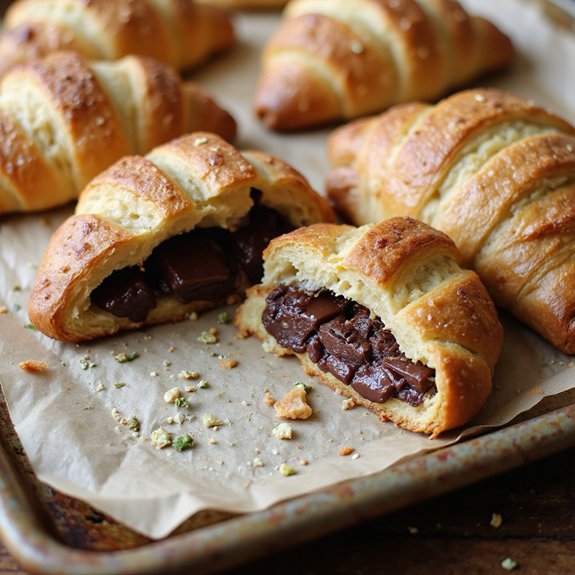
There’s something about tearing into a still-warm croissant, its sun-gold layers shattering into crisp flakes, that makes the whole kitchen go quiet.
Now imagine that same buttery pastry laced with deep, velvety chocolate and the gentle tang of sourdough—a cozy dessert (or indulgent breakfast) that tastes like a bakery project but fits into a relaxed home schedule.
These sourdough chocolate croissants are perfect for sweet-tooth fans, weekend bakers, and anyone who loves slow, satisfying recipes that reward a bit of planning more than hands-on time.
I first leaned on this recipe during a rainy Sunday when we needed cheering up but couldn’t run to our favorite café.
By evening, the house smelled of warm butter and cocoa, and a tray of croissants turned an ordinary day into something special.
They shine for lazy Sunday suppers, holiday brunches, or lingering coffee dates at home.
Ready to bring this dish to life?
Why You’ll Love It
- Delivers bold flavor from tangy sourdough, rich butter, and dark chocolate
- Creates ultra-flaky layers with classic French-style lamination at home
- Develops complex flavor and better digestion through long, slow fermentation
- Makes an impressive bakery-quality treat perfect for brunches or holidays
- Freezes beautifully for make-ahead breakfasts or last-minute dessert cravings
Ingredients
- 120 g active sourdough starter, 100% hydration — make sure it’s recently fed and bubbly
- 250 g whole milk, warm — gently warmed to just above room temp for easier mixing
- 60 g granulated sugar — adds sweetness and helps browning
- 1 large egg, room temperature — brings structure and richness to the dough
- 400 g bread flour — higher protein for strong gluten and flaky layers
- 50 g all-purpose flour — softens the dough slightly for tenderness
- 8 g fine sea salt — balances sweetness and enhances flavor
- 30 g unsalted butter, softened — mixes easily into the dough for richness
- 250 g unsalted butter, cold, for laminating — choose high-fat European-style for best flake
- 180 g dark chocolate batons or chopped dark chocolate — aim for 60–70% cocoa for balanced flavor
- 1 large egg, for egg wash — gives croissants a glossy, golden finish
- 15 g whole milk, for egg wash — thins the egg wash for even brushing
Step-by-Step Method
Mix the starter base
Whisk the active sourdough starter, warm milk, sugar, and egg in a large bowl until completely smooth.
Make sure the starter is fully dispersed with no lumps. This liquid base should look creamy and uniform. Proper mixing here helps the dough ferment evenly later and supports good gluten development during the next mixing step.
Bring the dough together
Add the bread flour, all-purpose flour, and salt to the bowl.
Mix with a dough scraper or spoon until a rough, shaggy dough forms. Scrape the sides and bottom to hydrate all dry spots. Aim for no visible dry flour, but don’t overwork it yet. The dough should look messy but cohesive.
Knead and enrich the dough
Knead the dough briefly by hand until it just comes together.
Add the softened butter and continue kneading 3–4 minutes. Work until the butter is fully absorbed and the dough feels smooth but still slightly tacky. Avoid adding extra flour. Shape it into a rough rectangle to make later rolling easier.
Rest and chill the dough
Cover the bowl tightly with plastic wrap or a reusable cover.
Let the dough rest at room temperature for 30–45 minutes to relax the gluten and begin fermentation. Then transfer the covered dough to the refrigerator. Chill for at least 6 hours or overnight until firm and thoroughly cold before laminating.
Prepare the butter block
Place the cold laminating butter between two sheets of parchment paper.
Pound and roll it into a neat 15 x 15 cm square, keeping the thickness even. Square off the edges by nudging them with a bench scraper if needed. Chill the butter until just firm yet pliable, not rock-hard or greasy-soft.
Encase the butter in dough
On a lightly floured surface, roll the cold dough into a 25 x 25 cm square.
Place the butter square in the center at a 45° angle, like a diamond. Fold each dough corner over the butter to meet in the middle, fully encasing it. Pinch seams gently to seal so the butter can’t escape.
Roll out the first lamination
Lightly flour the surface and top of the dough package.
Roll it into a long rectangle about 20 x 60 cm. Keep the thickness even and the edges straight by adjusting with your hands as you go. Use gentle, firm strokes, avoiding pressing so hard that the butter smears or breaks through.
Fold and chill the dough
Fold the long rectangle into thirds like a business letter, bringing one short end to the center and then overlapping with the other. This creates the first turn.
Wrap the dough snugly in plastic wrap to prevent drying. Chill it in the refrigerator for 30–45 minutes so the butter can firm up again.
Complete the second lamination
Rotate the chilled dough 90° so the folds face you differently.
Roll again into a 20 x 60 cm rectangle, keeping the butter layers even and contained. Fold it into thirds as before to complete the second turn. Wrap well, then chill for another 30–45 minutes to maintain distinct, cold layers.
Finish the third fold
Remove the dough from the refrigerator and place it with the folds oriented as before.
Roll once more to about 20 x 60 cm, steady and controlled. Fold it into thirds for the third and final turn. Wrap the dough tightly again and chill for at least 2 hours or overnight to relax gluten and firm layers.
Roll the final dough sheet
When ready to shape, place the laminated dough on a lightly floured surface.
Roll it into a rectangle about 25 x 40 cm, keeping thickness consistent. Trim the edges with a sharp knife or pizza cutter to neaten and reveal clean layers. Work quickly so the butter remains cold and defined.
Cut the croissant triangles
Using a ruler, measure and cut the dough into long triangles with bases about 8–9 cm wide and full height of the rectangle.
Alternate cuts to minimize scraps. Work with a sharp blade to avoid compressing the layers. Keep the triangles chilled if the dough starts to soften as you cut.
Add the chocolate filling
Lay each triangle flat with the base closest to you.
Place 2–3 chocolate batons or about a tablespoon of chopped dark chocolate along the base. Press the chocolate lightly into the dough so it adheres without tearing. Make sure the chocolate sits evenly to promote a uniform, melty center when baked.
Roll the croissants
Starting at the base, roll each triangle snugly toward the tip.
Slightly stretch the tip as you roll to create tension and a classic croissant shape. Avoid squashing the layers. Finish with the point tucked underneath so it doesn’t lift during proofing and baking, helping the croissants hold their form.
Arrange and proof the croissants
Place the rolled croissants on parchment-lined baking sheets, leaving ample space between them.
Cover loosely with plastic wrap or a large bag to prevent drying. Proof at a warm room temperature until puffy, jiggly, and nearly doubled, about 4–6 hours depending on your starter and ambient conditions.
Prepare the egg wash
Near the end of proofing, whisk together the egg and milk in a small bowl until completely smooth and homogenous.
Use a fork or small whisk. Strain if you notice streaks or clumps. Keep the egg wash chilled if your kitchen is warm, and have a pastry brush ready by your baking area.
Preheat and glaze the croissants
Preheat the oven to 200°C (390°F) with racks positioned in the upper and lower thirds.
Gently brush the proofed croissants with a thin, even layer of egg wash. Avoid the cut edges to preserve lamination and prevent sealing the layers. Work carefully so as not to deflate the delicate dough.
Bake and cool before serving
Bake the croissants for 10 minutes at 200°C (390°F).
Reduce the temperature to 180°C (355°F) and bake another 8–10 minutes, rotating trays halfway if needed. Look for a deep golden brown color. Transfer to a wire rack and cool at least 20 minutes so the crumb sets and chocolate thickens slightly.
Ingredient Swaps
- Flour: You can swap up to half the bread flour for all‑purpose if needed; avoid using 100% AP or whole wheat or the layers will be less lofty.
- Milk: Use any full‑fat dairy milk; for non‑dairy, choose a rich option (like barista oat milk) and expect slightly less tenderness.
- Butter: European‑style (82%+ fat) is ideal, but any unsalted butter works; for salted butter, reduce the added salt by 1–2 g.
- Sugar: Granulated, caster, or light cane sugars are interchangeable by weight.
- Chocolate: Any good dark or semisweet bar, chips, or feves can replace batons—aim for 55–70% cocoa.
You Must Know
– Scale – For a smaller batch, halve every ingredient by weight and keep lamination dimensions proportional (e.g., butter block about 10–11 cm square and dough rolled to ~18 x 35 cm).
Preserving the thickness ratios maintains the same flakiness and rise even with fewer croissants.
Serving Tips
- Serve slightly warm with a dusting of powdered sugar and a side of fresh berries.
- Pair with café au lait, hot chocolate, or strong espresso for a classic French-style treat.
- Plate alongside vanilla ice cream and drizzle with warm chocolate or salted caramel sauce.
- Slice and serve on a brunch board with fruit, yogurt, and a selection of cheeses.
- Rewarm briefly in the oven before serving to restore maximum flakiness and crispness.
Storage & Make-Ahead
Store baked croissants in an airtight container at room temperature for 1–2 days, or in the fridge for up to 4 days.
Re-crisp in a 180°C (355°F) oven for 5–8 minutes until the exterior is flaky again.
For longer storage, freeze baked croissants in a single layer, then transfer to a bag or container for up to 1 month.
Reheat from frozen at 160–170°C (320–340°F) for 10–12 minutes.
For make-ahead, shape the croissants and proof until just shy of fully risen, then freeze on a tray until firm.
Once frozen, transfer to an airtight container or bag and store for up to 1 month.
Bake from frozen, adding a few extra minutes, until they’re fully puffed and deeply golden.
Reheating
Reheat gently to preserve flakiness.
Warm croissants in a 160°C (325°F) oven 5–8 minutes.
For quick results, use a low-power microwave briefly.
Or use a covered stovetop skillet over low heat.
Sourdough Croissants in Cinema
Although we usually focus on measurements and technique, sourdough chocolate croissants almost feel like they belong on a movie set: all steam, shine, and slow, dramatic reveals.
When I pull a tray from the oven, I always think of those lingering close-ups in French films: the camera hovering as flakes drift like confetti, the soundtrack dropping to a hush so you can almost hear the crust crack.
If I were directing, I’d open on your hands tearing one open, the room filling with that buttery, tangy aroma.
The chocolate would stretch in a glossy ribbon, the crumb a pale honeycomb against the dark filling.
No dialogue, just the sound of your quiet exhale before the first bite.
Final Thoughts
Ready to give these sourdough chocolate croissants a try? Have fun baking, and don’t be afraid to tweak the chocolate, shaping, or timing to make this recipe truly your own.
Frequently Asked Questions
Can I Adapt This Recipe for a Gluten-Free Sourdough Starter and Flour Blend?
Yes, but I’d change expectations. I’d use a strong gluten‑free starter and high‑protein blend, add psyllium husk, chill very thoroughly, and expect tender, buttery layers rather than classic shatteringly crisp, stretchy flakes.
How Do Altitude and Humidity Affect Sourdough Croissant Lamination and Proofing Times?
They change everything: at high altitude dough proofs faster, butter softens quicker, and layers smear; in humid kitchens, gluten relaxes and proofing lingers. I’d chill often, watch the jiggle, not the clock, and trust your fingertips.
What Are Common Signs of Overworked Dough During Lamination and How Can I Fix It?
You’ll feel overworked dough fight back: tight, elastic, shrinking, butter smearing into streaks. I’d stop, chill it hard, dust lightly with flour, roll more gently, and lengthen rests so the gluten exhales and relaxes.
Are There Recommended Professional Tools for Scaling This Recipe for a Small Bakery?
You’ll want a small sheeter, 20–30 qt mixer, bakery proofer, and a convection deck oven; I’d add a precision scale, dough divider, and chill table so your butter stays cool and layers whisper-thin.
How Can I Calculate the Baker’s Percentages for This Sourdough Croissant Formula?
You’ll treat total flour (400 g bread + 50 g AP = 450 g) as 100%, then express everything else as a percentage of that; I’d guide you through starter, milk, sugar, butter like painting ratios.

Sourdough Chocolate Croissants
Equipment
- 1 digital kitchen scale
- 2 large mixing bowls
- 1 Small bowl
- 1 Dough scraper
- 1 Rolling Pin
- 1 ruler or measuring tape
- 2 rimmed baking sheets
- 2 sheets parchment paper
- 1 pastry brush
- 1 plastic wrap roll or reusable cover
- 1 Sharp knife or pizza cutter
- 1 pastry board or clean work surface
Ingredients
- 120 gram active sourdough starter 100% hydration
- 250 gram whole milk warm
- 60 gram granulated sugar
- 1 large egg room temperature
- 400 gram bread flour
- 50 gram all-purpose flour
- 8 gram fine sea salt
- 30 gram unsalted butter softened
- 250 gram unsalted butter cold for laminating
- 180 gram dark chocolate batons or chopped dark chocolate
- 1 large egg for egg wash
- 15 gram whole milk for egg wash
Instructions
- In a large bowl whisk together the active sourdough starter, warm milk, sugar, and egg until smooth.
- Add bread flour, all-purpose flour, and salt to the bowl and mix with a dough scraper until a rough shaggy dough forms.
- Knead the dough briefly by hand until it comes together, then add the softened butter and continue kneading 3–4 minutes until smooth but still slightly tacky.
- Shape the dough into a rectangle, cover the bowl tightly, and let rest at room temperature for 30–45 minutes.
- Transfer the covered dough to the refrigerator and chill for at least 6 hours or overnight until firm.
- Place the cold laminating butter between two sheets of parchment and pound and roll it into a 15 x 15 cm square, then chill until just firm but pliable.
- On a lightly floured surface roll the cold dough into a 25 x 25 cm square, place the butter square in the center at a 45° angle, and fold the dough corners over to fully encase the butter.
- Roll the butter-encased dough into a long rectangle about 20 x 60 cm, keeping edges straight and thickness even.
- Fold the rectangle into thirds like a letter, wrap in plastic, and chill for 30–45 minutes.
- Rotate the dough 90°, roll again to 20 x 60 cm, fold into thirds, wrap, and chill for another 30–45 minutes.
- Repeat the rolling and folding one more time for a total of three folds, then wrap well and chill for at least 2 hours or overnight.
- When ready to shape, roll the laminated dough into a rectangle about 25 x 40 cm, trimming edges to neaten if necessary.
- Using a ruler and sharp knife or pizza cutter, cut the dough into long triangles with a base of about 8–9 cm and full height of the rectangle.
- Place 2–3 chocolate batons or a tablespoon of chopped chocolate along the base of each triangle, pressing lightly so they adhere.
- Starting at the base, roll each triangle snugly toward the tip without squashing the layers, slightly stretching the tip as you roll.
- Arrange the rolled croissants on parchment-lined baking sheets with the pointed tips tucked underneath and spaced well apart.
- Cover the trays loosely with plastic wrap or a large bag and proof at a warm room temperature until puffy, jiggly, and nearly doubled, about 4–6 hours depending on starter strength and room temperature.
- Near the end of proofing, whisk together the egg and milk for the egg wash until smooth.
- Preheat the oven to 200°C (390°F) with racks in the upper and lower thirds.
- Gently brush the croissants with a thin, even layer of egg wash, avoiding the cut edges to preserve lamination.
- Bake the croissants for 10 minutes at 200°C (390°F), then reduce heat to 180°C (355°F) and bake another 8–10 minutes until deep golden brown.
- Rotate the trays halfway through baking for even browning if needed.
- Transfer baked croissants to a wire rack and let cool at least 20 minutes before serving so the crumb sets and chocolate thickens slightly.
Notes

Cynthia Weatherford is a seasoned chef and culinary enthusiast who serves as the Recipe creator of Somonday. With decades of experience in the kitchen and a passion for exploring diverse cuisines, Cynthia brings a blend of creativity and technique to every dish. Known for transforming simple ingredients into show-stopping meals, Cynthia believes that cooking is an art form anyone can master. Dedicated to inspiring home cooks, Cynthia shares approachable recipes, pro tips, and culinary wisdom to make every meal memorable.