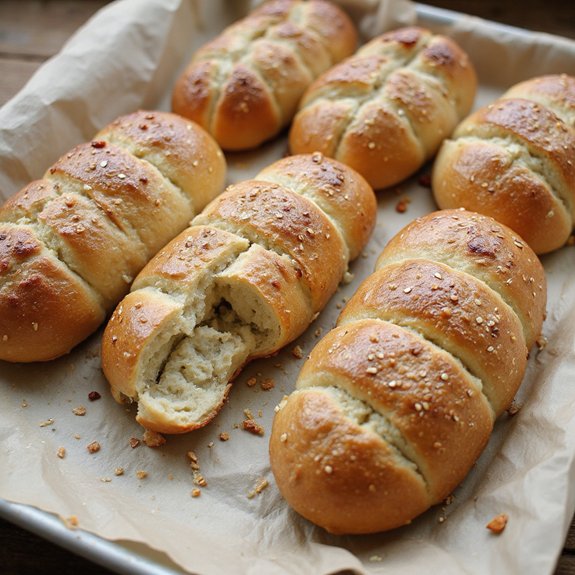
There’s something about a tray of freshly baked sourdough hoagie rolls, their crusts glowing a soft golden brown, that makes the whole kitchen feel like a neighborhood bakery.
As they cool, the crackly exterior gives way to a tender, chewy interior that’s just begging to cradle your favorite fillings—Italian meats, grilled veggies, or simple turkey and cheese.
These rolls are a cozy, make-ahead staple rather than a rush-to-the-table dinner, perfect for meal-preppers, sandwich lovers, and families who live on grab-and-go lunches.
I still remember the first time a batch of these rolls rescued me before a big game-day gathering: I’d plenty of deli fixings but nothing special to serve them on.
Those warm, sourdough-scented hoagies turned a basic sandwich bar into something everyone talked about.
They shine for Sunday suppers, picnic spreads, and easy entertaining.
Ready to bring this bakery-style staple to life?
Why You’ll Love It
- Delivers deep, tangy sourdough flavor in a soft, sandwich-ready roll
- Balances chewy crust with tender, fluffy crumb perfect for hearty fillings
- Uses simple pantry ingredients plus starter—no commercial yeast required
- Fits flexible schedules with room-temperature fermentation and visual proofing cues
- Freezes beautifully so you can batch-bake rolls for future meals
Ingredients
- 200 g active sourdough starter, 100% hydration — use recently peaked and bubbly
- 360 g water, room temperature — cool to the touch, not warm
- 30 g olive oil — a mild, good-quality variety
- 500 g bread flour — higher protein for better chew and structure
- 50 g whole wheat flour — adds flavor and color
- 12 g fine sea salt — avoids harsh, metallic flavors
- 20 g granulated sugar — helps browning and slight softness
- 1 large egg, beaten, for egg wash (optional) — gives a shiny, soft crust
- 15 ml water, for egg wash (optional) — thins the egg for easier brushing
- 15 g sesame seeds (optional topping) — for added crunch and nutty flavor
Step-by-Step Method
Mix the Starter Base
Whisk the active sourdough starter, room-temperature water, and olive oil in a large mixing bowl. Dissolve the starter as much as possible so it distributes evenly. This helps guarantee consistent fermentation and flavor.
Scrape the sides of the bowl as needed so no starter clings dryly to the edges.
Form the Shaggy Dough
Add bread flour, whole wheat flour, sugar, and fine sea salt to the bowl. Mix with a dough scraper or your hands until no dry flour remains.
Aim for a rough, shaggy mass rather than a smooth dough. Guarantee all ingredients are incorporated but avoid kneading at this stage.
Rest for Autolyse
Cover the bowl with plastic wrap or a clean kitchen towel. Let the dough rest for about 30 minutes at room temperature.
Allow the flour to fully hydrate and gluten to begin forming naturally. This rest makes the dough easier to knead and improves texture without extra effort.
Knead Until Smooth
Transfer the dough to a lightly floured surface. Knead for 8–10 minutes until the dough becomes smooth, elastic, and slightly tacky but not sticky.
Use a rhythmic push-fold-turn motion. Add as little extra flour as possible to keep the dough soft and maintain good hydration.
Bulk Ferment with Folds
Place the dough into a lightly oiled bowl and cover. Let it bulk ferment at room temperature for 3–3.5 hours.
During the first 90 minutes, perform 2–3 sets of stretch and folds. Lift and fold the dough over itself from all sides. This builds strength without overworking.
Check for Proper Rise
Watch for the dough to rise by about 60–70% in volume. Look for an airy, puffy feel when gently pressed.
It should feel lighter and show small bubbles along the sides. Avoid letting it fully double, which can lead to overproofing and weaker structure in the final rolls.
Divide the Dough Evenly
Turn the dough out gently onto a lightly floured surface to avoid degassing too much. Use a kitchen scale to divide into 6 equal pieces for uniform baking.
Cut with a dough scraper rather than tearing. Keep the pieces close together and lightly floured so they don’t dry out.
Preshape into Rounds
Shape each piece into a loose round by tucking edges under to create surface tension. Don’t tighten them too much yet.
Arrange the rounds on the work surface, leaving a little space. Cover with a clean towel and let them relax for 15 minutes to make final shaping easier.
Shape into Hoagie Rolls
Gently flatten each rested round into a small rectangle. Roll tightly from the long edge into a log about 6–8 inches long.
Seal the seam by pinching firmly and tuck the ends slightly. Aim for even thickness along the length so the rolls bake uniformly.
Arrange for Final Proof
Place the shaped rolls seam-side down on a parchment-lined baking sheet. Space them a few inches apart to allow room for expansion.
Cover loosely with plastic wrap or a towel. Prevent sticking by lightly oiling the plastic if needed. Keep them protected from drafts during proofing.
Proof Until Puffy
Let the rolls proof at room temperature for 45–75 minutes. Watch for them to become puffy and nearly doubled in size.
Gently press a fingertip into the dough; it should slowly spring back, leaving a slight indentation. Adjust proofing time based on your room’s temperature.
Preheat Oven and Prep Steam
About 20 minutes before baking, preheat the oven to 425°F (220°C). Place an empty metal pan on the lower rack to create steam if desired.
Ensure your baking sheet will fit on the middle rack. Preheating thoroughly helps achieve good oven spring and a nicely browned crust.
Apply Egg Wash and Seeds
If using egg wash, whisk the egg with 15 ml water in a small bowl. Gently brush the tops of the proofed rolls without deflating them.
Sprinkle sesame seeds over the egg-washed surfaces if you like. The egg wash adds shine and color, while seeds give extra flavor and texture.
Score the Rolls
Use a sharp knife or lame to score each roll down the center at a shallow angle. Make a single confident slash on each.
Scoring guides expansion in the oven and prevents random bursting. Aim for moderate depth so the cut opens attractively without deflating the dough.
Bake with Steam
Carefully pour a cup of hot water into the empty pan in the oven to create steam, then close the door quickly. Place the baking sheet on the middle rack.
Bake for 15–20 minutes until the rolls are deep golden brown. Steam helps develop a crisp, well-colored crust.
Cool Before Slicing
Transfer the baked rolls to a wire cooling rack immediately so the bottoms don’t become soggy. Let them cool completely, or at least 30 minutes, before slicing.
Cooling allows the crumb to set and moisture to redistribute. Enjoy fresh or freeze once fully cooled for later use.
Ingredient Swaps
- Use up to 50 g of the bread flour as all-purpose if needed; avoid replacing much more or the rolls may spread and be less chewy.
- Swap whole wheat flour with spelt or rye in equal weight for a more rustic flavor; reduce water by 10–15 g if the dough feels too sticky.
- For dairy-free, the recipe is already compliant; for vegan, skip the egg wash and brush with water or plant milk instead.
- Replace sugar with honey or maple syrup (same weight, not volume); or use 10–12 g sugar only if you prefer a less sweet roll.
- If you lack olive oil, use any neutral oil or melted butter in the same amount (30 g); butter will give a slightly richer, softer crumb.
You Must Know
– Make-Ahead – *To have fresh rolls on a busy day,* fully cool, then freeze in an airtight bag up to 1 month.
Rewarm at 325°F (165°C) for 8–10 minutes (unsliced) until the crust is crisp and the center feels soft and warm when gently squeezed.
Serving Tips
- Pile with Italian cold cuts, provolone, shredded lettuce, tomato, and oil-and-vinegar dressing.
- Serve warm with meatball marinara and melted mozzarella for hearty subs.
- Split and toast as garlic bread alongside pasta or salad.
- Use for grilled sausages with peppers, onions, and spicy mustard.
- Make breakfast hoagies with scrambled eggs, bacon, cheese, and hot sauce.
Storage & Make-Ahead
Store baked sourdough hoagie rolls in an airtight bag or container at room temperature for 2–3 days.
For longer storage, refrigerate for up to 4–5 days.
For make-ahead, bake, cool completely, then freeze for up to 2 months.
Thaw at room temperature and refresh in a 300°F (150°C) oven until warmed and slightly crisp.
Reheating
To gently reheat rolls, wrap in foil and warm in a 300°F oven for 8–10 minutes.
For quicker reheating, use a damp-towel-wrapped microwave burst or a covered skillet on low.
Hoagie Rolls in Culture
Long before I ever mixed my own starter into dough, hoagie rolls were already carrying stories, especially in East Coast sandwich shops where the word “hoagie” itself feels like local dialect for comfort.
When I think about hoagie rolls in culture, I think about how they quietly hold whole neighborhoods together—soft enough to bite, sturdy enough to catch every drip of memory.
- Wax paper crackling as a overstuffed sandwich lands on a Formica counter
- A game-day sub, sesame seeds scattering like confetti onto the couch
- A corner deli where the bread’s so fresh the crust still whispers when you tear it
- A late-night sandwich, hoagie roll soaking up sauce and secrets at the kitchen table
Final Thoughts
Give these sourdough hoagie rolls a try and enjoy how they elevate even the simplest sandwich.
Once you’ve made them once, have fun tweaking the toppings, size, or crust style to make them your own.
Frequently Asked Questions
Can I Convert This Recipe to Use Commercial Yeast Instead of Sourdough Starter?
Yes, you can. I’d swap the starter for about 7–8 g instant yeast, add 100 g water and 100 g flour, then let the dough rise until pillowy, domed, and fragrant before shaping.
How Do High-Altitude Conditions Affect Proofing and Baking These Hoagie Rolls?
High altitude makes dough rise faster and dryers your loaves. I’d watch for softer, puffier dough instead of the clock, shorten proofing, lower yeast slightly, and bake hotter, briefly, to capture that tender crumb and golden crackle.
What’s the Best Way to Make This Recipe Fully Whole Grain?
Use 100% whole wheat, then add 5–10% more water and a touch more oil. I’d mix gently, extend fermentation, and watch the dough swell like warm earth, yielding nutty, tender rolls with hearty chew.
Can I Mix and Knead This Dough Entirely in a Stand Mixer?
Yes, you can. I’d mix everything on low, then knead on medium-low until silky and stretchy. Watch the dough cling and slap the bowl, smooth and satiny, just clearing the sides but still softly tacky.
How Can I Adapt These Rolls to Be Gluten-Free While Keeping Good Texture?
You can, but I’d guide you toward a gluten‑free bread flour blend, extra psyllium husk, and slightly higher hydration; expect a softer, more tender crumb, like warm cloud‑soft pillows rather than chewy bakery crust.
Sourdough Hoagie Rolls
Equipment
- 1 large mixing bowl
- 1 Small mixing bowl
- 1 Kitchen scale
- 1 measuring cup
- 4 Measuring spoons
- 1 Dough scraper
- 1 clean kitchen towel
- 1 plastic wrap or dough cover
- 1 Baking sheet
- 1 sheet parchment paper
- 1 sharp knife or lame
- 1 wire cooling rack
- 1 pastry brush (optional, for egg wash or water)
Ingredients
- 200 gram active sourdough starter 100% hydration
- 360 gram water room temperature
- 30 gram olive oil
- 500 gram bread flour
- 50 gram whole wheat flour
- 12 gram fine sea salt
- 20 gram granulated sugar
- 1 large egg beaten for egg wash optional
- 15 milliliter water for egg wash optional
- 15 gram sesame seeds optional topping optional
Instructions
- Combine active sourdough starter, water, and olive oil in a large mixing bowl and whisk until the starter is mostly dissolved.
- Add bread flour, whole wheat flour, sugar, and salt to the bowl and mix with a dough scraper or your hands until a rough shaggy dough forms.
- Cover the bowl with plastic wrap or a towel and let the dough rest for 30 minutes to autolyse.
- After resting, knead the dough on a lightly floured surface for 8–10 minutes until smooth, elastic, and slightly tacky.
- Place the dough back into a lightly oiled bowl, cover, and let it bulk ferment at room temperature for 3–3.5 hours, performing 2–3 sets of stretch and folds during the first 90 minutes.
- When the dough has risen by about 60–70% and feels airy and puffy, gently turn it out onto a lightly floured surface.
- Divide the dough into 6 equal pieces, using a kitchen scale for accuracy if desired.
- Preshape each piece into a loose round, cover with a towel, and let rest for 15 minutes.
- Shape each round into a hoagie roll by gently flattening into a rectangle, then tightly rolling into a log about 6–8 inches long, sealing the seam well.
- Place the shaped rolls seam-side down on a parchment-lined baking sheet, spacing them a few inches apart.
- Lightly cover the rolls with plastic wrap or a towel and let them proof at room temperature for 45–75 minutes, or until puffy and nearly doubled.
- About 20 minutes before baking, preheat the oven to 425°F (220°C) and place an empty metal pan on the lower rack for steam if desired.
- If using egg wash, whisk the egg and 15 ml water in a small bowl, then gently brush the tops of the proofed rolls.
- Sprinkle sesame seeds over the egg-washed rolls if using.
- Score each roll with a sharp knife or lame down the center at a shallow angle.
- Just before baking, pour a cup of hot water into the empty pan in the oven to create steam, then quickly close the door.
- Place the baking sheet with the rolls on the middle rack and bake for 15–20 minutes, or until deep golden brown and hollow-sounding when tapped on the bottom.
- Transfer the baked rolls to a wire cooling rack and let cool completely or at least 30 minutes before slicing.
Notes

Cynthia Weatherford is a seasoned chef and culinary enthusiast who serves as the Recipe creator of Somonday. With decades of experience in the kitchen and a passion for exploring diverse cuisines, Cynthia brings a blend of creativity and technique to every dish. Known for transforming simple ingredients into show-stopping meals, Cynthia believes that cooking is an art form anyone can master. Dedicated to inspiring home cooks, Cynthia shares approachable recipes, pro tips, and culinary wisdom to make every meal memorable.